Retreat Sicily 2025
Beantwoorden
Qurbani 2025 Ivory Coast
Bismillah ir Rahman ir Rahim
Asalaam aleikum
Dear Brothers and Sisters
This year it is again possible to do Qurbani for the Eid al-Adha in Abidjan – Ivory Coast to help the poor in Abidjan
From May 28, 2025 to June 5, 2025

Abubakar Savannah coordinator Ivory coast (Abidjan)
– Qurbani : -The aim of sacrifice is to imbibe piety and self righteousness. It also promotes the spirit of sacrifice for a right cause. To explain its purpose, God says in the Quran. “It is not their meat, nor their blood, that reaches God, It is their piety that reaches God”: (22:37).

Qurbani goat costs : 130 euros
– Costs Ram Qurbani : 160 euros
– Costs Ox/beef: 840 euros (7x 120)

– all donations are also welcome to help develop the new Dergah in Abidjan
– Sheikh Nazim Madrassa School is open! Support them so they can grow

On the occasion of ʿĪd al-Aḍḥā 2025, we are organizing a Qurbani (ritual sacrifice) event for the needy.
All animals will be sacrificed according to prophetic tradition, and the meat will be distributed free of charge to the poorest families and people with mental health problems at the Zawiyah Mawlānā Shaykh Muhammad Nāẓim, as well as in other cities across the country, in a spirit of sharing, brotherhood, and raḥma (mercy).
This is a blessed opportunity to share the joy of the festival with the villagers and to demonstrate the generosity and nobility of the Muslim community. Participating in Qurbani means offering a meal, but also love, respect, and presence.
All donations are welcome to contribute to the development of the new Dergah in Abidjan.
Sheikh Nazim: The Madrassa school is open! Support them so they can grow.
All donations must be accompanied by the reason for the donation (Qurbani, Madrassa, or Zawiyah), and the name to be associated with it, if applicable.
Moneygram/RIA: Last Name SAVANE / First Name Aboubakar
BE 11 063221 2197 6148= iban bank number
Sheikh Aboubakar’s WhatsApp number: +33 6 43 96 58 70

THE SUFI DOCTRINE OF RUMI: Illustrated Edition
WILLIAM C. CHITTICK. FOREWORD BY SEYYED HOSSEIN NASR –
Reviewed by Samuel Bendeck Sotillos
“Hail, O Love that bringest us good gain—thou art the physician of all our ills”
–Rūmī
The outpouring of interest in RūMī(1207-1273) or as he is known within the world of Islamic spirituality, Jalāl al-Dīn Muḥammad Rūmī or simply Mawlānā, “our Master,” in the contemporary West is an overwhelming confirmation of the timeless relevance of traditional wisdom that isneither of the East or West. He is the originator of the renowned “mystical dance” (semā), which later became known as the “dance of the whirling dervishes” that is utilized by the Mevlevi or Mawlawiyya Sufi order founded by Rūmī ’s followers after his death. How is it that a poet from the thirteenth-century born in Balkh (Khurasan or present-day Afghanistan), who lived most of his life and was buried in Konya (Turkey), has become a celebrated figure in America today? This is again evidence of his universal message that transcends religious and sectarian boundaries, national, cultural, and ethnic divisions and is not limited to time or place. With the rise of Islamophobia, including extremism and xenophobia in all its forms, the message of the saints and sages such as Rūmī provide an antidote to the increasing ignorance, hatred, and violence that are besieging the world today.
THE SUFI DOCTRINE OF RUMI is a revised edition of a work that was initially published in 1974 in Iran by the Aryamehr University in Tehran to celebrate the seven-hundredth anniversary of Rūmī ’s death, when Professor Chittick was an assistant professor of Religious Studies at the university. This new edition is colorfully decorated with calligraphy, Persian and Turkish miniature paintings, which are truly stunning for the eye to gaze upon.
Seyyed Hossein Nasr, one of the world’s most respected writers and speakers on Islam and its mystical path, Sufism, was then the Chancellor of Aryamehr University. Nasr discusses the importance of this work for future Rūmī studies in his Foreword to this book:
[This] study of Dr. Chittick has the great merit…of approaching the subject [of Rūmī’s metaphysical teachings] from a strictly traditional point of view untainted by the modernistic fallacies which have colored most of the other studies devoted so far to this subject in Western languages.… May the message of Rūmī serve as a beacon of light to dispel the shadows which prevent modern man from seeing even his own image in its true form and from knowing who he really is.

Rūmī ’s major works are the DīWāN-I SHAMS-I TABRīZī of some 40,000 verses, and the MATHNAWī containing some 25,000 verses, which is often regarded as “the Qu’ran in the Persian language.” Although no work could fully encompass the totality of Rūmī ’s teachings, readers may ask, why yet another book? While numerous books are available they often miss the mark, and do not provide insight into the mystical symbolism of Rūmī ’s spiritual universe. Chittick speaks to his intentions behind preparing this work:
Despite numerous studies of him [Rūmī], until now there has been no clear summary in English of the main points of his doctrines and teachings…. For those who know [ Rūmī] only through the popularizing translations [of his poetry], this little book may provide some insight into his universe of meaning. Unlike most Sufi poets, Rūmī explains the meaning of his imagery and symbolism. My task is simply to juxtapose various verses and prose passages to let him say what he wants to say.

While Rūmī is well-known, and celebrated in the present-day, what is lacking are authoritative works accessible for general readers that offer an introduction in clear and accessible language to his magical poetry. This book does just that as it provides an authoritative and accessible presentation of Rūmī ’s magisterial teachings and its
fundamental themes vis-à-vis the Islamic tradition, which is central to his spiritual universe. The lack of knowledge pertaining to the Islamic tradition tends to obstruct Western readers from understanding the depth of Rūmī. Sufism is regarded as the inner or esoteric dimension of Islam and is a spiritual path by which the human being can transcend his or her individual egoism to reach the Divine. Chittick explains the distinction and relationship between the inner and outer dimensions of religion:
Exotericism by definition must be limited in some sense, for it addresses itself to a particular humanity and a particular psychological and mental condition— even though its means of addressing itself is to some degree universalized and expanded through time and space to encompass a large segment of the human race. Esotericism also addresses itself to particular psychological types, but it is open inwardly towards the Infinite in a much more direct manner than exotericism, since it is concerned primarily with overcoming all the limitations of the individual order.
Chittick clarifies the role of the Prophet Muhammad within Sufism as some have tried to separate Sufism from the Islamic tradition as if one could be a Sufi without being a Muslim:
For the Sufis themselves one of the clearest proofs of the integrally Islamic nature of Sufism is that its practices are based on the model of the Prophet Muhammad. For Muslims it is self evident that in Islam no one has been closer to God—or, if one prefers, no one has attained a more complete spiritual realization—than the Prophet himself, for by the very fact of his prophecy he is the Universal Man and the model for all sanctity in Islam. For the same reason he is the ideal whom all Sufis emulate and the founder of all that later become crystallized within the Sufi orders.
Rūmī confirms that all Sufi orders link back like a chain (silsilah) to the Prophet and that without the Prophet Muhammad there would be no Sufism.
This is expressed in his lyrical verse:
“God’s way is exceedingly fearful,
blocked and full of snow. He [the
Prophet] was the first to risk his life,
driving his horse and pioneering the
road. Whoever goes on this road, does
so by his guidance and guarding. He
discovered the road in the first place and
set up waymarks everywhere.”
To the surprise of many Rūmī admirers, who would never accuse him of being narrow-minded, rather than being against orthodox interpretations of religion, Rūmī speaks of orthodoxy as a spiritual necessity to the union with the Divine: “The (right) thought is that which opens a way: the (right) way is that on which a (spiritual) king advances.”

The following is another poetic articulation of Rūmī ’s perspective on orthodoxy: “Alter yourself, not the Traditions: abuse your (dull) brain, not the rose-garden (the true sense which you cannot apprehend).”
According to Rūmī, the true nature of the relationship between the Divine and the world of form requires a transcendent wisdom that is outside the reach of normal or rational knowledge:
It…is neither inside of this world nor
outside; neither beneath it nor above it;
neither joined with it nor separate from it:
it is devoid of quality and relation. At
every moment thousands of signs and
types are displayed by it (in this world).
As manual skill to the form of the hand,
or glances of the eye to the form of the
eye, or eloquence of the tongue to the
form of the tongue (such is the relation of
that world to this).
Although the Divine confirms the unity of all phenomena in the manifest world, when viewed through the lens of the relative or duality, all things appear as separate and disjointed from one another without a trace that they are essentially interconnected on a higher level. Likewise, knowledge cut off from its transcendent source characterizes the fallen consciousness of humanity.
Chittick writes, “The fall of man is the result of the blinding of the ‘eye of the heart’ (chashm-i dil or ‘ayn al-qalb), which alone sees with the vision of gnosis.” Due to the fallen consciousness which attaches itself to what is transitory, human beings do not see things as they are but rather in a distorted way: “Therefore union with this (world) is separation from that (world): the health of this body is the sickness of the spirit. Hard is the separation from this transitory abode: know, then, that the separation from that permanent abode is harder.”

According to Rūmī, the fallen consciousness of Adam extends and includes the whole of humanity:
Sick, surely, and ill-savored is the
heart that knows not (cannot
distinguish) the taste of this and that.
When the heart becomes whole (is
healed of pain and disease), it will
recognize the flavor of falsehood and
truth [since “God taught Adam the
Names”]. When Adam’s greed for the
wheat [the forbidden fruit] waxed
great, it robbed Adam’s heart of health
….discernment flees from one that is
drunken with vain desire.
The loss of the sense of the sacred is itself the forgetting of the Divine. Rūmī asserts, “Forgetfulness (of God), O beloved, is the pillar (prop) of this world; (spiritual) intelligence is a bane to this world.”
Sufism teaches that Universal or Perfect Man (al-insān al-Kāmil) is the prototype of both the microcosm and the macrocosm, the human being and the cosmos. This is to say that Universal or Perfect Man is “the perfect human model who has attained all the possibilities inherent in the human state.” For Universal or Perfect Man the misidentification with the empirical ego has relinquished itself, “the human ego with which most men identify themselves is no more than his outer shell”. Chittick explains the need for consciousness to be in ceaseless contemplation of the Real in order to remedy the forgetfulness of the Divine: “the maintenance of the world depends on the balance between the contemplative who has realized the state of Universal Man, and fallen man, who lives in a state of forgetfulness.” The theomorphic identity of all human beings is the Universal or Perfect Man as Rūmī instructs:
The owner of the Heart [Universal or
Perfect Man] becomes a six-faced
mirror: through him God looks upon
(all) the six directions. Whosoever hath
his dwelling place in (the world of) the
six directions, God doth not look upon
him except through the mediation of
him (the owner of the Heart)….
Without him God does not bestow
bounty on any one.

Rūmī reminds readers that the original function of every human being is to be the Universal or Perfect Man in order to act as a channel of grace in the world. In fact, not to do so, is to forfeit what it means to be human:
There is one thing in this world which
must never be forgotten. If you were to
forget everything else, but did not
forget that, then there would be no
cause to worry; whereas if you
performed and remembered and did
not forget every single thing, but forgot
that one thing, then you would have
done nothing whatsoever.
The saints and sages of the world’s religions remind the human collectivity of his or her original or theomorphic nature and provide methods of realizing
this transpersonal identity:
In the composition of man all sciences
were originally commingled, so that his
spirit might show forth all hidden things,
as limpid water shows forth all that is
under it—pebbles, broken shards, and the
like—and all that is above it, reflecting in
the substance of the water. Such is its
nature, without treatment or training.
But when it was mingled with earth or
other colors [when Adam fell], that
property and that knowledge was parted
from it and forgotten by it. Then God
most High sent forth prophets and saints,
like a great, limpid water such as delivers
out of darkness and accidental coloration
every mean and dark water that enters
into it. Then it remembers; when the soul
of man sees itself unsullied, it knows for
sure that so it was in the beginning, pure,
and it knows that those shadows and
colors were mere accidents.

Identity itself belongs to the Divine and thus the mystery of human identity cannot be resolved without the inclusion of what transcends the empirical ego. Rūmī astutely writes:
“The idol of your self is the mother of (all) idols….”
Whether the human being chooses to do good actions or evil ones, all creation confirms the existence of the Absolute. Rūmī writes,
“…(both) infidelity and
faith are bearing witness (to Him): both
are bowing down in worship before His
Lordliness.”
The secret of the Prophetic Tradition that affirms “Die before ye die” is a call for self- effacement before the Divine in order to be reabsorbed in the Divine. Rūmī states that ultimately death in this life is an alchemical process of spiritual transformation; it is a
journey of homecoming and not of departure in order to return to the Supreme Identity:
O you who possess sincerity, (if) you want
that (Reality) unveiled, choose death and
tear off the veil [of your self-existence]—
Not such a death that you will go into the
grave, (but) a death consisting of
(spiritual) transformation.
Rūmī casts light on the famous, yet no less controversial dictum by the great Sufi mystic al-Hallāj (858-922), which is an instruction on how to approach the Divine:
Take the famous utterance “I am God.”
Some men reckon it a great pretension;
but “I am God” is in fact a great humility.
The man who says “I am the servant of
God” asserts that two exist, one himself
and the other God. But he who says “I
am God” has naughted himself and cast
himself to the winds. He says, “I am
God”: that is, “I am not, He is all,
nothing has existence but God, I am pure
nonentity, I am nothing.” In this the
humility is greater.

The deepening of our understanding of the mystical dimension of the religions will aid in creating more spiritual literacy across the faith traditions and will simultaneously revive the meaning and significance of the outer or formalistic dimension of religion. For Rūmī and all saints and sages of the sapientia traditions are upholding the right understanding of their own faith traditions and how to approach them accordingly.

The shahādah or the essential declaration of faith in Islam, Lā ilāha illallāh, “There is no god but God,” when seen through the discerning and contemplative “eye of the heart” becomes a crystalline distillation of Rūmī ’s metaphysical teachings. Two main steps on the Path are contained in the shahādah, the first consisting of the “annihilation of self” (fanā) and the second the “subsistence in God” (baqā), for when the illusory nature of human identity dissociated from the Divine reality is seen for what it is and it becomes evident that the Divine is all that exists, concentration on the Real becomes possible. This formula can also be understood as “There is no self but the Self” or, correspondingly, “There is no reality but the Reality,” being universal in principle and applicable to all faiths.
As the centuries pass, Rūmī continues to demonstrate his profound presence in the hearts and minds of those who are attracted to his message, which calls for nothing less than are sacrilization of this world and union with the Divine. The importance of this book is that it guides readers through the fundamental themes of Rūmī ’s complex spiritual labyrinth, making his symbolic language intelligible to readers unfamiliar with his teachings or the mystical dimension of Islam. It is truly remarkable to find the timeless in time; and it is not only through Rūmī but all of the saints and sages of the world’s faith traditions where such examples of pure metaphysics can be found, urging a resurgence of the sacred that is ever present in this very moment. We conclude with two lines from Rūmī ’s DīWāN inviting all to take part in the pilgrimage of the Heart:
“Make a journey out of self into [your real] self,
O master, / For by such a journey
earth becomes a quarry of gold.”


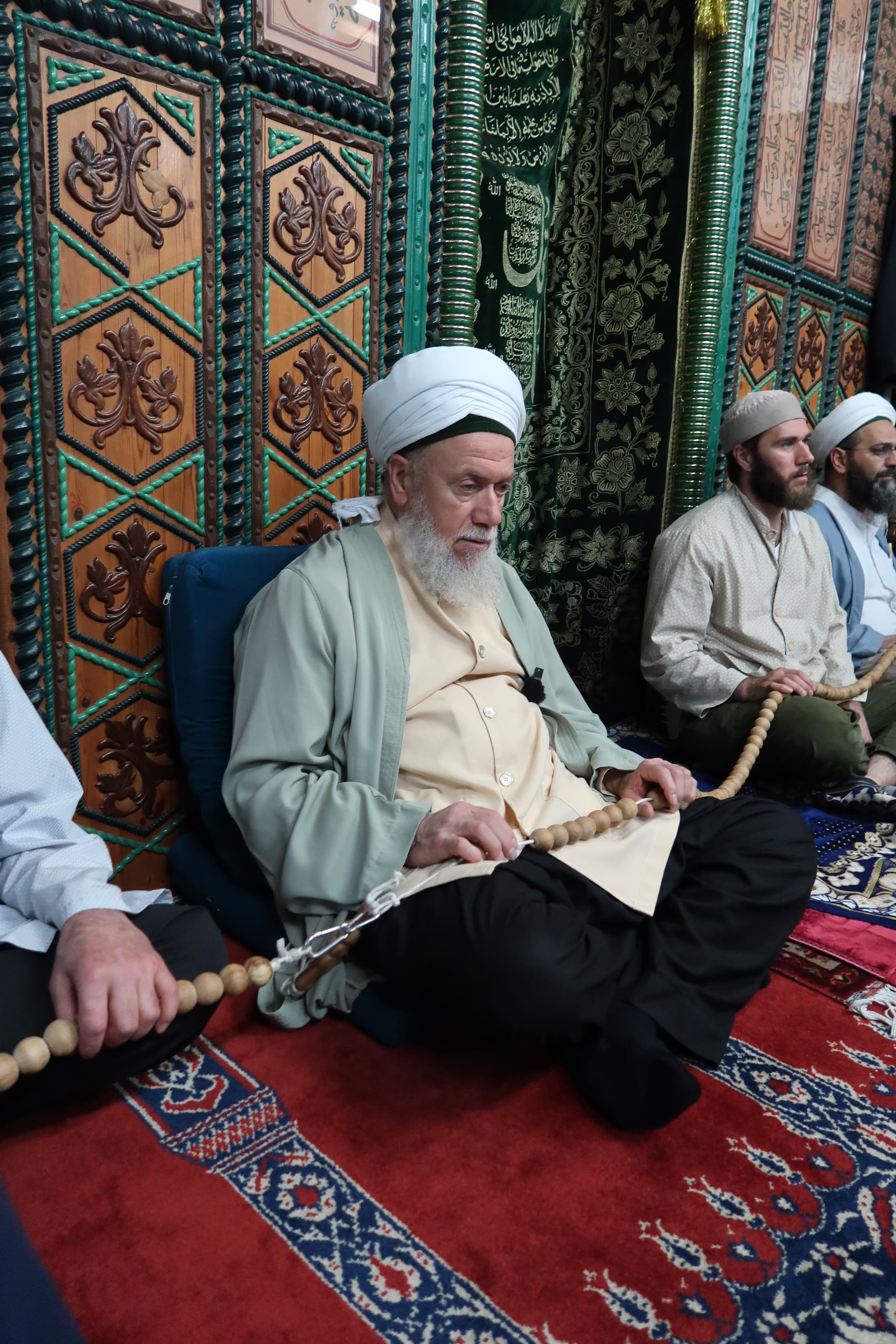
Mawlana Is Always With Us*
Mawlana Sheikh Muhammad Adil ar-Rabbani -07 May 2025/ 09 Dhu l-Qa’dah 1446 -Lefka, Cyprus
As-Salāmu ‘Alaykum wa RaḥmatuLlāhi wa Barakātuh.
A‘ūdhu BiLlāhi Minash-shayṭāni r-rajīm. BismiLlāhi r-Raḥmāni r-Raḥīm. Wa ṣ-Salātu wa s-Salāmu ‘alá Rasūlinā Muḥammadin Sayyidi l-Awwalīna wa l-Akhirīn. Madad yā RasūlAllāh, Madad yā Sādāti Aṣḥābi RasūliLlāh, Madad yā Mashāyikhinā, Dastūr Mawlana Sheikh Abdullāh al-Fā’iz ad-Dāghistāni, Sheikh Muḥammad Nāẓim al-Ḥaqqānī. Madad.
Ṭarīqatunā aṣ-Suḥbah wa l-Khayru fi l-Jam‘iyyah.
Shukr to Allāh جل جلاله, we gathered here again for the sake of Allāh جل جلاله. We gathered here to continue on that way with the beloved servants of Allāh جل جلاله. We always gather, but our gathering today is for the anniversary of the passing of the awliyā’uLlah Mawlānā Shaykh Nāẓim. He passed away, but shukr to Allāh جل جلاله, he didn’t leave us. He even didn’t leave us outwardly. He gives his madad to all his murīds. He gives them strength, spiritual power.
Sometimes many murīds ask how to make Rābita, how to hear a voice in Rābita. Rābita is your love for our Holy Prophet صلى الله عليه وسلم and to mashāyikh. To love them is our Rābita. Rābita isn’t “Should I do this? Should I not do that?” That’s fine too, but there’s no need to give instructions for Rābita, “My son/my daughter, do this, do that.” Whoever wants such things doesn’t know the principles and ethics. When you enter ṭarīqah, you surrender. You surrender to your murshid. If you’ve found a real murshid, you should thank Allāh جل جلاله not a thousand times, but a million times. When you surrender, you have reached salvation. But may Allāh جل جلاله protect us, if you get stuck with those who claim they’re murshid for another purposes , may Allāh جل جلاله help you. Because they follow their ego. And since the way is for their ego, it is of no benefit. But if you go on the way of the murshid, shukr to Allāh جل جلاله. Life is passing by anyway. Then, it won’t be wasted in vain. It will be filled with thawāb, barakh and beauty.
If you’re going to wander around striving in vain, “What should we do today? Where should we have fun today? How should we make money? How can we get intoxicated? How can we impress others to like us?” This is empty work. There’s a nice saying of the Turks, “empty work.” That’s empty work. Living for dunyā, for your own interests, for your ego is empty work. If your life is going to be full, you must go on the way of Allāh ‘Azza wa-Jalla, the way of mashāyikh, and surrender.
Don’t think that it is empty. It is filled with Allāh’s جل جلاله permission. May Allāh جل جلاله protect us. As we said, what’s empty is those who think, “How much will I earn from dunyā?” Their life passes in vain and meaninglessly. May Allāh جل جلاله protect us, apart from it being in vain, it is full of evil, full of sins. May Allāh جل جلاله protect us.
Therefore, asking himmah and help from the mashāyikh is beneficial. Being on that way with them is a protection for you. It gives value to your life. Your life becomes beneficial. “This guy lives like grass. He goes from his house to his job, and from his job to his house. He doesn’t borrow money. He doesn’t complain about the government. He doesn’t get angry at this or that.” He doesn’t live like grass. Those living like grass, living like a poisonous grass are the others. Those who think they are something and get angry at everyone. Those who expect benefit from everyone. Those who do all kinds of filth and all kinds of ḥarām to satisfy their own egos are the ones who live in vain. We must be like grass. Grass is good. There is harmful grass, and harmless grass. Everyone knows the meaning of grass. Ours is, in shā’a Llāh, of light and īmān. May we be of the servants whom Allāh جل جلاله loves. May we not be like the grass they consume, but be as the beneficial grass, in shā’a Llāh. May Allāh جل جلاله protect us.
Shayṭān has already taken over the world with his hand. He doesn’t want to leave anyone. Those who are saved cling to the rope of this way. Those who cling to Allāh جل جلاله are the ones who are saved. Others think they are saved or have won but there is no such thing. Therefore, being with mashāyikh, following them is the greatest gain for a person. Not to be on their way is a great danger. May Allāh جل جلاله protect us. Every second, every moment shayṭān may slip your feet and you will have fallen into his trap. May Allah جل جلاله protect you.
May our Shaykh’s himmah be with us. Shukr to Allāh جل جلاله, as we said, it has been eleven years since our Shaykh has passed away. But every minute we are under his gaze, we are under his himmah. Those who ask for his himmah, he will definitely come to his aid. He doesn’t leave him. There are people who don’t believe and those group who don’t believe in awliyā’, karamāt and miracles. And they claim they are Muslim. But the condition of being a Muslim is believing in the miracles of our Holy Prophet صلى الله عليه وسلم, believing in the karamāt of the awliyā’, that is also one of the fundamental conditions of the creed of Muslims.
Therefore, shukr to Allāh جل جلاله, you are here. To those who came, may Allāh جل جلاله be pleased with you. There are many who haven’t come. Their hearts are together with us. Mawlānā Shaykh Nāẓim reaches them all with the permission of Allāh جل جلاله. May Allāh جل جلاله be pleased with you. May Allāh جل جلاله change the state of this world, and send the Sāhib. As Mawlānā Shaykh Nāẓim said that Mahdi ‘alayhi s-salam will appear, in shā’a Llāh.
Wherever you look, dunyā is in the hand of shayṭān. One hundred percent in the hand of shayṭān. To get rid of shayṭān is only through Mahdi ‘alayhi s-salam. It can’t be any other way; no matter what they say.
Wa min Allāhi t-Tawfīq. Al-Fātiḥa.


“Allah created ego [nefs] and asked him to come to His presence; but ego went back. When Allah asked him to go back, he came nearer. Whatever Allah ordered, ego did the opposite. Allah asked him, ‘Who am I and who are you?’, ordering him to declare that he is servant to Him. But ego said ‘I am myself, you are yourself!’ Allah ordered to put ego into the prison of Hell’s fires for 1000 years. After 1000 years, He called him back and asked the same question. Ego gave the same reply. Thereupon, Allah ordered to put ego into the prison [of cold hells] for 1000 years. After 1000 years, He called ego again and asked the same question; ego again gave the same reply; ‘I am myself, you are yourself’, and not said ‘I am your servant’. Then Allah sentenced ego to hunger for 1000 years. When it was complete, Allah called him again and asked ‘who am I and who are you?’ Trembling, ego said, ‘I am your big servant; you are my Lord’ [meaning, ‘though being a servant to You, I am at least still superior to all Your other servants’]”
~ Mawlana Shaykh Nazim Adil Al-Haqqani
(8 March 1992 — the Peckham Mosque).


“Our donkey is our ego.” – Mawlana Shaykh Nazim
The Prophet (s), Habeebullah, what was he saying?
Allahumma laa takilnee ila nafsee tarfata `aynin
O Allah, don’t leave me to my ego for the blink of an eye.
Therefore, we are asking for heavenly support against our egos. Our ego is attacking us and asking to take the reins to make us its donkey, to do as it likes. I am using “it” because to say “that” would give it an honor. “It” is for animals and you may use “it” for that which doesn’t have any soul or living things on it. Always put Shaytan down. Put it down. Don’t give Shaytan any honor. Don’t use any honorable word for Shaytan. That is important!
I am saying A`oodhu billahi min ash-Shaytaani‘r-rajeem. O our Lord! We are asking humbly for protection against Shaytan and its followers. That is important. Dastoor yaa Sayyidee, yaa Sultaanu ‘l-Awliyaa. We are saying, O our Master, O Qutbu ‘z-Zamaan, O Qutbu ‘l-Mutassarif who has been granted from heavenly stations to look after this world and everything that is happening on it. Don’t think that this world is just left as it likes to be through space. Everything is under control very carefully, daqeeq, control must be on everything. Nothing can be in existence without its Creator knowing about it. How can it be? He creates and He knows a dharrah, an atom can’t know about itself.
You mankind, do you know about yourself? Are you able to know about yourself? Who knows? People are trying to know something around themselves but not themselves! Our eyes may look around us only but cannot look into our inner beings. If I ask you, “Where is your liver?” Many people don’t know. If we ask, “Where is your heart?” “I do not know.” Man is ignorant, fully ignorant about himself.
We are saying A`oodhu billahi min ash-Shaytaani‘r-rajeem because Shaytan is always trying to confuse people and not letting you know. It has been said that a person has 360 organs, small and big, and yet you do not know about yourself! How come you are asking to know around yourself? Don’t say that it is knowledge to look into space saying, “That is polestar, that is the sun, that is the moon, that is seven sisters, that is alpha systems.” It is nothing, it gives you nothing.
It is not real knowledge around you that you are looking at. How many of you understand yourself? How are your organs working? You are eating and enjoying it. You are drinking and enjoying but where is it going inside? What is its significance? You don’t know. You are only drinking and eating. And you man have been granted such an honor and your honor is to know! No other creature on this planet knows about themselves because they don’t have a mind or they can’t think. And their levels are animals’ levels but your level is over the level of angels!
«We ask to be no-one and nothing,
For, as long as we are someone,
we are not complete.»


St George and Al khidr – 23 April
Hıdırellez or Hıdrellez (Turkish: Hıdırellez or Hıdrellez; Azerbaijani: Xıdır İlyas or Xıdır Nəbi; Crimean Tatar: Hıdırlez; Romani language: Ederlezi) is a folk holiday celebrated as the day on which the prophets Al-Khidr (Hızır) and Elijah (İlyas) met on Earth.[1] Hıdırellez starts on the night of May 5 and ends on May 6 in the Gregorian calendar, and April 23 (St. George’s day for the Christians) in the Julian calendar. It is observed in Turkey, Crimea, Gagauzia, Syria, Iraq, the Caucasus, and the Balkans and celebrates the arrival of spring.
Khidr (Arabic: ٱلْخَضِر, romanized: al-Khaḍir), also transcribed as al-Khadir, Khader, Khizr, al-Khidr, Khazer, Khadr, Khedher, Khizir, and Khizar, is a figure described but not mentioned by name in the Quran as a righteous servant of God possessing great wisdom or mystic knowledge. In various Islamic and non-Islamic traditions, Khidr is described as a messenger, prophet, wali, slave, or angel who guards the sea, teaches secret knowledge, and aids those in distress. As guardian angel, he prominently figures as patron of the Islamic saint Ibn Arabi. The figure of al-Khidr has been syncretized.
Hıdırellez is regarded as one of the most important seasonal bayrams (festivals) in both Turkey and parts of the Middle East. Called Day of Hızır (Ruz-ı Hızır) in Turkey, Hıdırellez is celebrated as the day on which the prophets Hızır (Al-Khdir) and İlyas (Elijah) met on Earth.[3] The words Hızır and İlyas fused to create the present term. Hıdırellez Day falls on May 6 in the Gregorian calendar and April 23 in the Julian calendar. In other countries the day has mostly been connected with pagan and Saint George cults.
The word Hıdırellez, born out as a compound form of Hızır and İlyas, they are regarded as two different persons. In respect to religious sources, there are several references on İlyas; However, there is no slight mention about Hızır. The perception of seeing Hızır and İlyas as identical arises from the fact that İlyas stands as an obscure figure within the context of Tasavvuf (Sufism) and popular piety when compared to Hızır and there are numerous legends on Hızır, whereas little is known about İlyas and furthermore, there are many great maqams of Hızır, yet there are only few maqams for İlyas. Ali the Fourth Caliph is associated with Hızır within Alevi-Bektaşi belief system.
St. George is the figure corresponding to Hızır in Christianity. Besides being associated with St. George, Hızır is also identified with İlyas Horasani, St. Theodore and St. Sergios. St. George believed by Muslims to be identical with Hızır, is also believed to be similar to some Muslim saints; St. George is identified with Torbalı Sultan and Cafer Baba in Thessaly, Karaca Ahmet Sultan in Skopje, which is a mounting evidence how St. George and Hızır have influenced St. George’s Day and Hıdrellez Day ceremonies.

Hıdırellez or St. George Day is also celebrated under the name Dita Verës (Summer Day) in Albania which was originated by the pagan cult in the city of Elbasan – the so-called Zana e Çermenikës- the goddess of forest and hunting. It is celebrated on March 14 and symbolizes the end of winter and the beginning of spring and summer. At the same time, in different regions of Albania, it is celebrated among some other communities known as Dita e Shëngjergjit, St. George Day on May 6.
Hıdırellez is widely spread celebration in most Syrian territories, but mainly practiced in the rural areas. We have information about spring rituals practiced since ancient times. Those rituals are the manifestations of the celebration for the arrival of spring and summer. Further of the symbol of spring and resurrection of life that is, so called ever-green, ever-return Al-Khidr prophet. Rituals take place annually on May 6. People, Muslims and Christians, regardless of their religious affiliation, celebrate the living Alkhidr prophet that is St. George or Mar Georgeos. The cult of celebration of St. George has become influential over the formation of Eid Alkhidr in Syria as well. The two names are identical. People go to picnic to the natural places, practicing the rituals of celebration, including performing folk music, singing and dancing. In the area of Zabadani for example, people used to gather around a tree aged about 800 years as a symbol of the ever-return Alkhidr.
One widespread belief suggests that Hızır has attained immortality by drinking the water of life. He often wanders on the earth, especially in the spring, and helps people in difficulty. People see him as a source of bounty and health, as the festival takes place in spring, the time of new life.[1] To date, the arrival of spring or summer, figuratively meaning the rebirth of nature or the end of winter, has been celebrated with ceremonies or various rituals at every place in which mankind lives. Within the seasonal cycle, winter symbolizes death; spring symbolizes revival or regeneration of life. Thus, time for the days full of hope, health, happiness and success comes. Therefore, Hıdırellez Day is highly significant since it is believed to be the day on which Hızır and İlyas met on the earth, which is accepted as the arrival of spring/ summer.
In Turkey, it is widely believed that Hızır is the prophet who while bringing fertility to man wanders on the earth and as for the prophet İlyas, he is accepted as the water deity. In order to fulfill some of their missions, these two prophets wander around the land and the sea throughout the year and meet on May 6. This meeting stands for the fusion of the land and water.
Today, the ceremonial activities for Hıdırellez are prevalently and elaborately prepared especially in villages or towns rather than metropolises. The preparations for the celebrations are associated with the issues as cleaning the house and the garments, dress, finery and food-drink and doing shopping for the feast. The indoor of the houses and the outdoor places as gardens are supposed to be clean, because Hızır is expected to visit the houses on that day. Almost everywhere, garments and other apparels and food-beverages are common components of Hıdırellez ceremonies. All the preparations related to the ceremonies are of particular concern to the young men or women, since Hıdırellez is regarded as the most proper occasion for the youth-willing to marry in the future-to find a suitable match.
Hıdrellez ceremonies are held in the countryside near the cities, towns or villages where generally streams, lakes or other water springs exist. By great majority, there are tombs or shrines open to visits in those locations which are placed on hills. Bearing the specific features, Hıdırlıks are particularly chosen for Hıdırellez ceremonies.
As Hızır is believed to be a healer, some ritual practices as regards to health issues can be seen on Hıdırellez Day. On that day, meals cooked by lamb meat are traditionally feasted. It is believed that on Hıdırellez Day all kinds or species of the living, plants and trees revive in a new cycle of life, therefore the meat of the lambs grazing on the land which Hızır walks through is assumed as the source of health and happiness. In addition to these, some special meals besides lamb meat are cooked on that day.
The other ritual practice for seeking health and cure is the ritual of jumping over the fire which is built by old belongings or bushes. While uttering prayers and riddles, people jump over the fire at least three times. That fire is called Hıdırellez fire; hence, it is believed that all illnesses or diseases are warded off all the year long. Another ritual practice for having good health on Hıdırellez Day is to be awash or bath by water brought from some holy places.
It is believed that all the wishes and prayers come true on the eve and the very day of Hıdırellez. If one wishes to have more properties, s/he makes a small rough model of it onto the ground in the garden and Hıdırlık. Occasionally, the wishes or prayers are written on a piece of paper and thrown under the rose trees, etc.[1]
Furthermore, within the scope of Hıdırellez ceremonies in Turkey and the countries mentioned, some practices related to seeking for good fortune and luck can be seen. One of those practices is the tradition called “mantufar, martifal etc.”, which is played to have good fortune. On 5th of May, the girls or women seeking for good fortune, luck or a suitable match to marry put their rings, earrings etc. into a pot. Then, the pot is closed after pouring some water into it. Afterwards, the pot is left under a rose tree for one night and the following day, women put the pot in the middle of the crowd and take their belongings out while reciting mâni (rhyming Turkish poems).
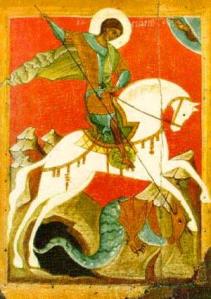
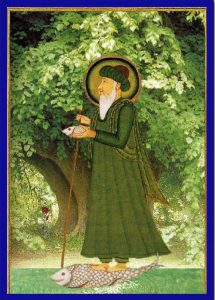
At first sight there seems to be little connection between Elijah, George and Khidr, apart from the fact that in the Middle East they are frequently associated with the same place by different religious traditions. Is it then a simple case of overlapping traditions, Jewish, Christian and Muslim, all of whom focus on the Holy Land as part of their own heritage and take Abraham as their forefather?
Certainly there is a view which suggests that Khidr is to Muslims what Elijah is to Jews, in respect of them both acting as initiator to the true believer, and which in itself is testimony to attempts to find common ground between the three traditions.
The sacred sites associated with Elijah, George and Khidr over centuries seem to have accumulated worship in various forms, so that one sits quite literally on top of or next to another. The sites often exhibit similar attributes: for instance, the presence of water and greenness, suggesting fertility in a barren land; or perhaps a cave, which represents a meeting-place of two worlds, the manifest and the hidden (and on occasion both elements are present, as at Banyas).
Then there is the ancient theme of the spiritual side of man being dominant over the material, as suggested in the stories by the holy rider on a chariot or horse (or in the case of Khidr, a fish).
This is a clear picture of the divinised human, who comes to deliver mankind:
Elijah is zealous for God and the destroyer of false prophets,
while St George is the conqueror of animality in the form of the dragon;
Khidr’s role is rather less vividly martial – he brings real self-knowledge, delivering the individual from the false and base nature of the soul.
In all three cases one can remark the polarity of the monotheist or true believer and the pagan or ignorant: Elijah and the prophets of Baal, St George and the emperor Diocletian, for example and perhaps most strikingly in this respect, Khidr who points out the interior meaning of this opposition and is thus the educator of Moses.
However, we should note significant differences in their status, which in part reflect the religious context in which they appear: Elijah is a prophet, in a long line of prophecy; St George is a saint, martyred for his faith in the tradition of Christianity; Khidr, however, is almost a nobody – he is neither saint nor prophet, but an ordinary person graced with immortality and initiatic significance. While the first two are usually portrayed as mounted, Khidr has his feet upon the ground (or just above it in some stories) or walks on water; as we shall see, he has a most particular role to play in mystical teaching. Read more here
Sultan al Awliya Mawlana Shaykh Nazim al-Haqqani 2 September 2009 Lefke, Cyprus
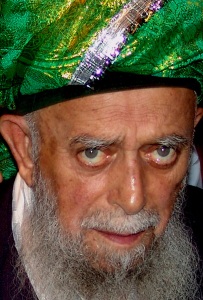 …In the holiest month, Ramadan. Blessed month. And through this blessed month I am trying to reach something from spirituality. Through spirituality I am asking to reach the level of holy ones, that holy ones they are blessed ones. Blessed ones and O people! If you are not going to reach blessings from heavens through your whole life, what is the benefit of your existence here?
What does it mean? It means nothing nothing! Why? Why you are not asking “Am I in existence to be nothing? To be like a dust?” It is big blame, O people! if I am not asking that question, “For what I am in existence? What is the main aim of my being in existence? For what I have been granted eyes, ears, tongue, hands, feet and a perfect figure? Yes, man just created on a perfect figure. No any other created as a man. The creation of man it is perfect.
But if you are not thinking Who granted to you who is figure, designer, for you, for what granted that to you , you must think on it. Designer of man on same womb, designing some babies as a man. Designing some babies as a baby girl or baby boy. As He likes. You are not putting your will there to say “I must be figure of man.” Or “I must be figure of lady.” Or no one can say, “I must be red color or white color or ? color or green color.”
“O Shaykh we are never hearing of green color man!”
“Yes, we must be. You are not looking east and west. Say to top people that you must do and you must look and find green men also.”
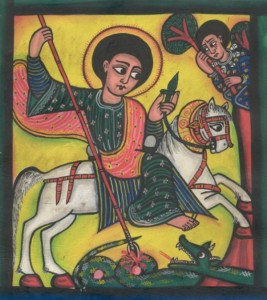 Yes there is green men, it is true. there is green man. Only one, but he is not also, his face green, but that is then Christians saying St. George, but we are saying Khidr (as) . Green man, chevalier St. George. Always in his hand he is killing a dragon. Very good. It is very very and a important symbol that they are making a figure on a horse through his hand a spear and killing a dragon. So many people they are taking only looking to that figure, but really that figure asking to teach people.
O people! That one who is a famous personality through creation, through his hand with a spear killing a giant gigantic dragon.
O people! Look what does it mean? It means that St. George going to be a saint because he killed that dragon that it is representing our egos. Killing and going to bury the same. O people! ! Enough to carry your feelings that belongs all of them to your dragon. Leave that feelings and kill that one then everyone going to be a St. George, a blessed one in the Divine Presence. And that Green Man is only one. And asking to teach people “O people! Til your most terrible enemy, the dragon is killed…but you are not taking any care of it.
As everyone knows that every prophet they were sitting on earth, not on thrones. There are some exceptions, doesn’t matter, but mostly whole prophets sitting on earth with poor people, weak people, native people, and aseer, (slaves) slave people. They were sitting with those people and that not taking honor from them but giving honor because they are trying to give something to our Lord’s creatures. They tried to make people best ones, not the worst ones. Who is working for their egoes and no other aim for them is except their dragons? Therefore don’t try to be “First Lady”or “Number One” in America, in Turkey, in England, in Russia.
Who is first one? Who is best one? Don’t think that every first one going to be best one. Everybody thinking first one. First one they claim but it is not important. Important is that one who is claiming to be best one. Are you best one? Give answer to me. To be “First One” if making you best one, bravo. If not then it is a very dangerous situation to be “First Lady”or “Number One” through nations. No. Only if you are asking our honor in Divinely Presence. Yes, you may claim, “I am first one on earth” but on heavens do you think your name written under tables of best ones? Old Testament, New Testament, Psalms and Holy Quran what there are saying? What are they teaching people? Teaching them to be best ones or worst ones? Say! Popes say! Archbishops say! Patriarchs say! Presidents say! Philosophers say! Hindus say! Buddhists you may say! The Lord of heavens asking from you to be first ones or best ones? That is the main source of troubles on earth.

Look also to St george day- 23 April
Mawlana said that we have entered the time of Sayyidina Al-Mahdi (as) and the the command for Muslims now is to distinguish themselves from non-Muslims to be under Divine protection and “The Green – Yeşil” is the door.
THE GREEN
Shaykh Mohammad Nazim Al-Haqqani An-Naqshibendi, Sohbat of the 30th of September, 2012.
Bismillahi r-Rahmani r-Rahim.
To the people of this time: Which is the most beautiful color? It is green. Who wears a green cap, a green dress; who paints their houses green; who keeps a green flag on their cars- these ones are seen from above & are under protection. There is no protection for any other color, only for green.
Let everybody hang green flags on the endpiece of their cars. Green… If they like they can put on it the old flag of Egypt, it is green. Turks also have green. They also can put Turkish flag. They should put green flag. If the sky came down to earth, it wouldn’t touch them.
Who uses green dress, green cap, nothing comes on him. Who pays attention to wearing green dress, at least whatever dress he/she puts on should be green. Green is the heavenly protection. It is heavenly protection. They should pay attention to green. May Allah forgive us. Fatiha.
Green is the most beautiful of the colors. It is the color of life, it has descended from Heavens. Therefore they should pay attention to this. Fatiha.
No harm touches the one who loves green in dunya & in akhirah. This is the new instruction from Heavens: Green, it is the color of life. It is the color the angels love. Sundus, sundus al- akhdar (fine green silk). It is green, it is the most beautiful color of the paradises. Sundus, therefore they should wear it. The scarf on their head, green silk. They can put embroidery or needlework on it, whatever they want to do. Basically they should put green cap. They don’t suffer from headache. These ones don’t suffer from headache. There is a special angel that protects them. If all that the sky carries of punishment came down to earth, it won’t touch them.
Like this, vest also should be green. If they circulate this green color, the heaviness in the world will be lifted. Let them be careful about this. They should love the green color. It has the love of the habitants of paradise in it- sundus al-akhdar/green silk. Is it not? O Allah, You know. There are things to come on those who don’t love it. There is special angel to protect those who wear green. There is an angel who descends from Heavens. Let them pay attention to this. Women and men, all. At least they should put green rosette (pin) on their chest. It protects them.
Ladies should prefer dark colors. Dark colors should be preferred, should be the choice of the ladies. Therefore I don’t like light colors, I don’t like at all. May Allah forgive us. Fatiha.
If they are to paint the outside of their houses, they should prefer green. They should choose for dresses the green ones. They should prefer green color in the furniture they use. It brings them good luck. Green color brings good luck. Other colors are unlucky except the green color, it is the color of life. They should wear it, use it. These people become lucky. The people of this time should pay attention to this also. They don’t say “O my head, O my teeth.” Who covers his/her head with a green cover will not suffer from headache.
The latest fashion of Islam in the end of times is this, our fashion is this. Everything other than this and something will befall them. They should at least put something green around their necks. They should at least put green turban/ cotton cover on their heads. Let their cars be green. I will make green ghalib/victorious. Green prevents punishment. It turns away calamity. It turns away accidents and calamities. This is also a new instruction. Be careful about this. Fatiha.
Men should wear green rosette on their chests. Ladies should wear green colored stones, jewelry. If green prevails in the world all troubles will go away & finish. O Lord, may You forgive us. May You send us Your servants who will teach us. There is divine protection in the color green.
The cars also, they have something for flags. They should put a green colored flag on it- with 3 crescents, or with 3 stars, or with 1 crescent & 3 stars. It should be green. No accident or calamity comes on them. May Allah forgive us.
Green brings majesty, angels love it. The color of fire- the people of this time have a tendency for red. Their fashion is red. It is fire, it burns them. Green gives comfort, gives beauty, gives peace, gives barakah. Be careful about this. O the ladies of this time, adorn yourselves with green. Fatiha.
The greenery. Use the greenery that grows in nature, the greenery that grows in nature by the power of Allah Almighty. Eat them, grow them & have no fear. Meat makes you wild. Vegetables & greens make you friendly & soft. It makes you kind & ladylike, or it makes you a gentleman. Or else you become a wild animal. Allah… May Allah forgive us.
Fatiha.
Today, 21 April 2025, marks the 103th birthday of Maulana Sheikh Nazim al Haqqani( q). May Allah grant him the Highest Maqam!


On April 21 1922, Shaykh Sharafu d-Dīn (q) informed Shaykh ‘Abdu Llāh (q) that a baby was born in faraway Cyprus who would be a pure inheritor of the Prophet ﷺ and bring many to the guidance of Islām. Today is the hundredth and secondth anniversary of Mawlana Shaykh Nāẓim al-Ḥaqqānī’s (q) birth, a day to be thankful.
Today marks the day that Allah adorned this world with Sultan Awliya, Mawlana Sheikh Nazim (q) .Allah sent him to us, during the darkest times, and with him came Nur (light) to fill generation after generation with Nur Allah.
Happy Birthday Mevlana Sheikh Nazim (q)
We pray that we also are rewarded and join you when our time comes, for eternity, Insha’ALLAH! Thank you Mevlana (q) for saving us from ourselves
«We ask to be no-one and nothing,
For, as long as we are someone,
we are not complete.»

Bismillah ir Rahman ir Raheem
The world is rolling slowly and irresistibly into a dark tunnel.
Nobody knows what will happen in this tunnel. We only know of its existence because Allah Almighty has informed us of it. We know from prophetic utterances that this tunnel will have an end and that of all those who enter it, only a few will reappear.These are not my own words. It is mentioned in all of the Holy Books which say, when human beings stop listening to reason, when they throw wisdom out of the window and follow only the advice of their egos, they will slide into a narrow,terrible tunnel. This tunnel will wash away all evil and all dirt. Now day by day, step by step, the world is sinking deeper into it.
Darkness is spreading, and outside the air is frozen. The way through this tunnel is difficult, very difficult, but those who are fortunate enough to leave it again, will find themselves in a world suffused with light and peace. May the Lord Allah Almighty help us. We beg for help in the battle against our most terrible enemy, our own ego, in the battle against our-selves.
Gun-barrels, tanks and bombs are not in the position to call it to a halt. It is only too familiar with such weapons and does not fear them at all.
No, the only weapon which can stop its terrible course, the only one which can teach it fear, is something completely different. It is something which hardly any-one thinks about any more when he is looking for help.
It is the unity of God.
It only submits to that. This, and nothing else, is the message of Islam. All religions agree upon this. They all call people to the unity of Allah Almighty and gather them together into this unity.
They all tell us how we can attain to the power of God or how we can be prepared for it to come to us.
When people meet in the unity of Almighty God, then wars will cease between them. This is something which our ego does not want to happen at all. It is not in its interest that it happens. It does not want to come together with anything or anyone. It wants to be alone and to stay alone, always in front, always on top. Nobody may accompany it, nobody may go alongside it, others must be underneath it, at its feet.
These are its demands, and so it remains from the beginning of mankind to the end. However, religions do not accept this. When we say lâ ilâha illâ Llah, there is no God except Allah, then everyone who says this wholeheartedly is called into the Oneness of God Almighty.
The freedom to serve page:15 from Islam,The freedom to serve by sheikh muhammad nãzim ãdil al-Haqqãni
Suhbats, Aphorisms and Stories, Sheikh Nazim’s Lectures and more… – Free download

ShaykhNazimHaqqani-BridgeToEternity


The first English translation of Qadi Iyad’s definitive text Ash-Shifa. For a thousand years this majestic book has guided the Muslim community in their beliefs and practices concerning the Messenger ﷺ , in particular and the risalah (the message) in general.

Kitab Ash-Shifa bi ta’rif huquq al-Mustafa (Healing by the recognition of the Rights of the Chosen One), of Qadi ‘Iyad (d. 544H/1149CE) is perhaps the most frequently used and commented upon handbook in which the Prophet’s life, may Allah bless him and grant him peace, his qualities and his miracles are described in every detail.
Generally known by its short title, Ash-Shifa, this work was so highly admired throughout the Muslim world that it soon acquired a sanctity of its own for it is said: “If Ash-Shifa is found in a house, this house will not suffer any harm… when a sick person reads it or it is recited to him, Allah will restore his health.”
This book gathers together all that is necessary to acquaint the reader with the true stature of the Prophet ﷺ. Here Free Dowload
The author: Qadi ‘Iyad (476 – 544 AH/1083 – 1149 CE)
Qadi ‘Iyad Ibn Musa Al-Yahsubi was born in Ceuta during the time of the Murabitun. He travelled to Andalus to study and in Cordoba he learnt from such luminaries as Ibn Rushd, the grandfather of the Qadi and philosopher of the same name. Iyad was already accepted in scholarly circles when he was eighteen and was appointed Qadi when he was 35 becoming first the Qadi of Ceuta in 515 AH/ 1121 CE and later Granada in Spain in 531 AH/ 1136 CE. He was exemplary in his knowledge of the sciences of hadith from which ocean he drew his astonishing work ash-Shifa.
The Translator: Aisha Bewley
Aisha Abdurrahman Bewley is one of today’s most prolific translators of classical Arabic works into English. For more than thirty-five years she has been concerned with making the contents of many classical Arabic works more accessible to English-speaking readers. She is co-translator of The Noble Qur’an A New Rendering of its Meaning in English.
Table of Contents:
Part One : Allah’s Great Estimation of the Worth of His Prophet expressed in both Word and Action :
—Chapter [I] Allah’s Praise of him and His Great Esteem for him,
—Chapter [II] Allah’s perfecting his Good Qualities of Character & Constitution, and giving him all the Virtues of the Deen and this World,
—Chapter [III] On the Sound & Well-Known Traditions related about the Immense Value placed on him by His Lord, His Exalted Position and His Nobility in this World and the Next,
—Chapter [IV] On the Miracles which Allah manifested at the Prophet’s Hands and the Special Properties and Marks of Honour (Karamat) with which he honoured him.
Part Two : Concerning the Rights which people owe the Prophet, may Allah bless him & grant him peace, :
—Chapter [I] The Obligation to Believe in him, Obey him, and Follow his Sunna,
—Chapter [II] On the necessity of Loving the Prophet, may Allah bless him and grant him peace,
—Chapter [III] Exalting him and the Necessity to Respect and Honour him,
—Chapter [IV] The Prayer on the Prophet and asking Peace for him, and the Obligation of doing it, and It’s Excellence.
Part Three : On what is necessary for the Prophet, may Allah bless him and grant peace, and what is impossible for him, and what is forbidden for him and what is valid in those human matters which can be ascribed for him :
”This part is the secret of the book and it’s core of the fruit. What comes before it lays the foundation and provides the proofs for the clear anecdotes we will relate in it. It governs what follows it and accomplishes the goal of this book. When its promise is put to the test and its duty fulfilled, the breast of the accursed enemy will be constricted and the heart of the believer will shine with certainty and its lights will fill his breast. The man of intellect will then value the Prophet, may Allah bless him and grant peace, as he should be valued ”.
—Chapter [I] Concerning matters of the Deen and the Prophet’s, upon them be peace, being Protected from Imperfection,
—Chapter [II] The States of the Prophet in Respect of this World and what non-essential human qualities he could have.
Part Four : The Judgements Concerning those who think the Prophet, imperfect or curse him, may Allah bless him & grant peace, :
—Chapter [I] Clarification about cursing the Prophet or saying that he is imperfect by allusion or clear statement,
—Chapter [II] The Judgement against someone who curses the Prophet, reviles him, disparages him or harms him, and how someone who does this should be punished; about calling on him to repent and the status of his inheritance,
—Chapter [III] Concerning the Judgement on anyone who curses Allah Almighty, His Angels, His Prophet’s, His Books, and the Family of the Prophet and His Companions,
Appendices :
—Glossary of Arabic words,
—Glossary of Hadith Collections referred to in the text,
—Glossary of People mentioned in the text,
—Synopsis of Section Contents,
—Biographical Note on the Author of the Shifa.

Sohbat Sheikh Hassan -English translation
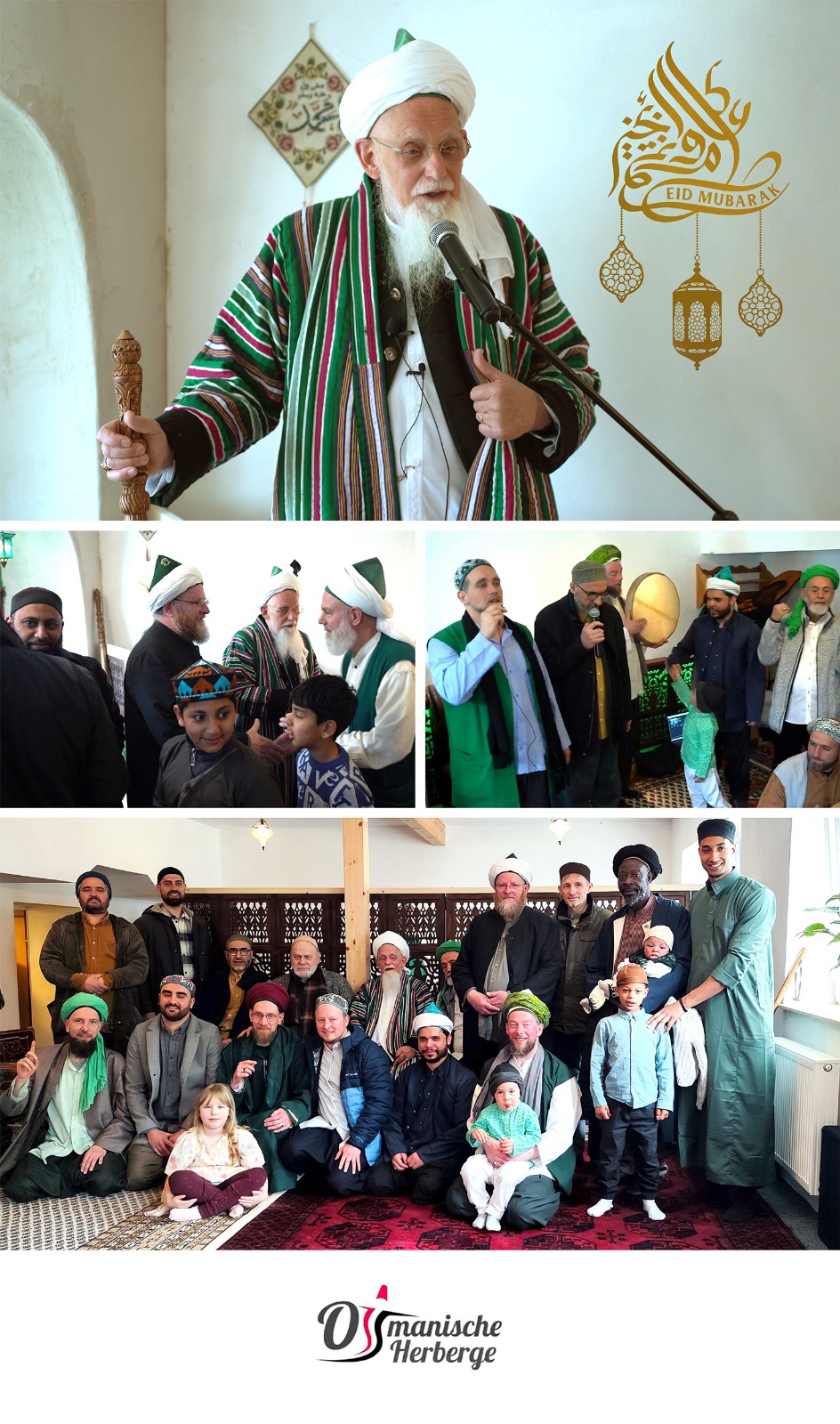
30th March 2025, Osmanische Herberge Kall
Ayyuhal Mu’minun!
Oh you brothers and sisters! Eid Mubarak! Eid Mubarak is gathering for the celebration of the end of Ramadan. Ramadan flew by, that’s how it felt, mashallah and Allah ﷻ gave his gifts to everyone who asked for them. May Allah ﷻ accept it and protect us and let us keep what we have achieved, or what we have received, the gifts we have been given in our hearts – the Mu’mins, Muslims – and to live with and expand them until the next Ramadan inshallah.
It is not easy to maintain one’s mental state and attention, given the situation in this world, which is becoming 99% crazy, where there is no longer any rationality or reflection. There is no more thinking, you can’t find anyone who still thinks anywhere, among the politicians, among the leaders of the countries, who only oppress their own countries and other countries with bad qualities – with greed and with a lust for power.
These are all characteristics that reflect ourselves. Every human being has such characteristics that can only come from the human being – and they come from the human being, because every human being basically has four enemies. We have no external enemies, no other countries are our enemies, no other person is your enemy, you are your own enemy and you have your enemies within you who want to pull you away from your faith. And these enemies are the ego – the Nafsul-Ammara Bissu – and Hawa – the desires that arise from there – and this world that seduces you, and Shaytan that combines them all. Shaytan combines these and whispers to us and occupies us. And it’s good for nothing, nothing at all. And running after the Dunya is good for nothing, for nothing. Not in this world – in this world you will suffer if you have this attitude, and in Akhira even more. There’s only suffering there.

The only thing that can satisfy us and make us happy is to increase our faith, increase our knowledge – our knowledge that Allah ﷻ is with us. Allah ﷻ is with you – you have to know that. You have to think about it carefully, and know it, and think about it, and meditate on it – that you are not here, sitting, from somewhere, by chance: „Somehow I was born, from my father, my father fathered me and my mother gave birth to me and now I’m sitting here.“ – No! Allah ﷻ brought you here and no one else. This is something you have to think about and know carefully, so that you know and raise your awareness about the presence of Allah subhana wa ta’ala – Who is always with you, Who is always with you. Wherever you are, wherever you go, whatever you do, He is with you and He sees you.
And everyone writes down, the angels write down what you do. It’s like in a computer, nothing is missing. Everything is seen on Yawmul-Qiyama – every little deed, every little emotion, every little thought, every little deed is registered and is seen, and then you are judged. And who judges you? Yourself! You yourself are your main judge, you will see what your fate is after this life. That’s why we should try.
Here came the question of the brotherhood, of maintaining a brotherhood. Don’t just be a Muslim who sometimes goes to the mosque for Eid, and goes to the mosque on Friday and otherwise doesn’t worry about anything. You have brothers and sisters. You have brothers and sisters who are on the way, that is valuable, very valuable – having a companion. These are the companions. The greatest, most famous companions are the companions of the Prophet Muhammad sallallahu alayhi wa sallam, Ashabi kiram. Why are they called companions? Because they were his companions, they swore allegiance to him. Have you sworn loyalty? Take the oath of allegiance! We did it. Our Jama’at takes the oath of allegiance to our Sheikh, our spiritual guide.

Without a spiritual guide there is no path, and no loyalty, and no security on this path – without a spiritual guide, without a Murshid. Everyone agrees on that. The whole Ahlus-Sunnah wal-Jama’at all over the world agree that every Muslim needs a Murshid. It’s not enough to come to Juma once a week and then say, ‘I’m on the right track.’ That is not enough. That is not enough for happiness. That is not enough to fulfill your heart. It is not enough to come to beauty, to wisdom, to the divine oceans.
Allah ﷻ is merciful. He himself says, subahana wa ta’ala: „My mercy is greater than my anger.“ Alhamdulillah! Alhamdulillah! No matter how weak we are, no matter how weak we are, no matter how many mistakes we make, Allah ﷻ has mercy on us and forgives us. Therefore, use this time to ask for forgiveness. That was Ramadan and it continues, it is not finished, the forgiveness is always open, the granting of forgiveness is always open. And forgive your brothers and sisters if they have done something to you. Do not quarrel, do not quarrel with them, and do not put fire to the quarrel, the separation.
Shaytan tries to separate us, he is the separator. He wants to separate you so that you have no companion on the path of faith. That’s why he says: „Be with the people, be with the party people, be with the show people, be with those who don’t believe in Allah ﷻ, be with those who give you the freedom, where you can do whatever you want, dance, drink, do drugs, anything, anything you can do.“ Shaytan tells you ‘it doesn’t matter, it’s okay’ – and it’s a path to unhappiness, to dependency and unhappiness, to endless sadness, to endless suffering. And the opposite is being with the good guys. Be with good people! Tell your children, ‘be with good people!’ Don’t let them go anywhere. Take care of your children, you have responsibilities, you have responsibilities. Allah ﷻ asks you: „What have you done with your children?“ – „Yes, I let them go there, to the disco and everywhere, let them do everything so that they would be happy – because they were always complaining and moaning – I gave them everything.“ You will be condemned for this.
There is the beautiful way, there is the right way, there is the clean way and we have to live by it. And we have responsibility for our families. And the men who head the family are asked. They will be asked: „What did you do to your family, to your children, to your wife? How did you treat them? How did you treat them, when you know that the best Muslim is the one – and the best Mu’min – who treats his wife most kindly and treats his family most kindly. Have you treated your family kindly?“ – „No, I beat her. I beat her and oppressed her, and oppressed my children.“
It’s a bad sign and a bad end. The Prophet ﷺ clearly stated what we should do and what we should not do. Why don’t you listen to that? Find someone to tell you that. It’s not enough to look at the books every now and then, it’s not enough. You need someone who is the example, who shows you how to treat your family, how to treat your brothers and sisters, how to deal with justice. You need an example, a living example. Do you have such an example? Then follow this example – there are! Allah ﷻ leaves them for us in this world. Allah ﷻ does not leave us alone and says: „I leave you to your fate, do what you want, you are with Shaytan and you are with it…“ – No! There are my friends, says Allah ﷻ, Awlyia kiram, the friends of God – they are there, they are the ones you have to look for and follow – not people who are hypocrites.
There are such hypocrites among Muslims, all over the world, who say: „Don’t love the Prophet ﷺ too much, you can’t say Salawat, you can’t do this, you can’t do that, you’re doing Shirk, you’re doing association.“ And Muslims, simple Muslims who don’t know Arabic – and the people, who say something like that, they know Arabic – they say: „Oh! He knows Arabic, he knows more than me.“ Nope! He doesn’t know more than you, he’s one Shaytan. This is a shaytan who wants to seduce you. You are Bosnian or something else and your heart tells you otherwise, your heart says: „Love the Prophet ﷺ more and more, and love the people, and love the brothers and sisters, through the love of the Prophet ﷺ.“

And do Salawat sharifa as much as you can – more and more. It will be good for you. It will be for the best for you. It will give you contentment in this life and the next life – instead of giving importance to this world. Don’t worry about politics. Don’t worry about what happens. Crazyness is happening now. Madness is upon us. The madness of the ego – the ego that says ‘I am independent.’ And people can’t think. We have some smart people who say something every now and then, mashallah, you can see on social media, in the media sometimes, they are still thinking. And they tell us clearly and prove that our people, our politicians, cannot think. They can’t think. Don’t assume that they can think, think about anything, observe anything, judge anything logically – they can’t do that. We are ruled by zombies, by – I don’t know what to call them – by madmen who have no idea where we’re going. This is the case all over the world, everywhere. This can be observed especially in our country, mashallah. All wrong decisions, wrong decisions, all against people – against people, against their peace, against their well-being, against all reason. There’s not an ounce of reason, not an inch of reason, it’s just the way the decisions are made.

And don’t worry about it – it’s like that! Allah ﷻ wants it that way. Nothing happens that Allah does not want. Allah ﷻ also wants this so that Mahdi alayhi salam can come. Mahdi alayhi salam is coming and will turn all this world around. He will make Batil Haqq everywhere, and he will establish Haqq all over the world. And only he can do it, only he has permission, it has to be someone who has permission from Allah subhana wa ta’ala. It can’t be done by just anyone with any ideas. It is one who has the power, the power of Allah ﷻ subhana wa ta’ala – he will do it. You can’t do it. Politicians can’t do it. Even the people who want something good can’t do it. Shaytan is established everywhere, he has his power everywhere, everywhere and you can’t change anything anywhere.
Therefore, take care of your heart, O Mu’min, be with your heart, be with Allah ﷻ and know that Allah ﷻ does everything, and prevents everything that He does not want. What He doesn’t want doesn’t happen, what He wants happens, and no matter how terrible it looks, it is as it is, as Allah ﷻ wills. You must know this, and you must be content, and you must guard your heart with your faith and with your Islam. Don’t get the idea of not praying. Pray! You have to pray. You must meet Allah ﷻ five times a day, surrender. Don’t say, „I only pray once, only twice, or only Juma or something like that.“ That won’t be enough for you, it won’t be enough to survive this bad world and the bad events that are coming now.
May Allah ﷻ protect us, inshallah, fill our hearts with Iman and with confidence. Stay with your heart, stay with Allah ﷻ, there is always confidence. Stay with the Prophet, sallallahu alayhi wa sallam, in his love, increase his love and do not worry about anything else, inshallah.
May Allah ﷻ protect us and increase our faith, increase our faith, inshallah.


 Sufi Path of Love