In the Name of God, Most Compassionate and Merciful
Ibn Kathir says:
“The Mu’min are a people who have been prevented through the Qur’an from indulging in the pleasures of this world; it comes between them and what might destroy them. The Mu’min is like a prisoner in this world, who tries to free himself from its shackles and chains, placing his trust in nothing in it, until the day he meets his Creator. He knows full well that he is accountable for everything that he hears, sees and says, and for everything that he does with his body.”
(Al-Bidayah wa al-Nihayah, vol. 9 pg. 276, Cairo 1352)
There are two kinds of people, one are those whose Nafs have overcome them and led them to ruin because they yielded to them and obeyed their impulses. The other kinds are those who have overcome their Nafs and made them obey their commands.
Nafs (pl. Anfus or Nufus) lexically means soul, the psyche, the ego, self, life, person, heart or mind. (Mu’jam, Kassis)
Although some scholars have classified the Nafs up to 7 stages, there is agreement among Ulama’ that in the Qur’an, Allah (s.w.t.) has described at least 3 main types of the Nafs. And these are in rank from the worse to better: Nafs al-Ammara Bissu’ (the Nafs that urges evil), Nafs al-Lawwama (the Nafs that Blames) and Nafs al-Mutma`inna (the Nafs at Peace).
(Chapter 12 v. 53 in the Tafsir of al-Tabari: Jami’ al-Bayan fi Tafsir al-Qur’an, 30 vols., Bulaq 1323 & also in Imam Baghawi’s Tafsir: Lubab al-Ta’wil fi Ma’alam at-Tanzil, 8 vols. Cairo, 1308)
A summary of these states of the Nafs are given by Imam Tabari in his Tafsir of Surah Yusuf verse 53:
1. Nafs al-Ammara Bissu’ (The Soul which Commands):
This is the Nafs that brings punishment itself. By its very nature it directs its owner towards every wrong action. No one can get rid of its evil without the help from Allah. As Allah refers to this Nafs in the story of the wife of al-Aziz (Zulaikha) and Prophet Yusuf (s):
“The (human) soul is certainly prone to evil” (12:53).
Allah also says:
“And had it not been for the grace of Allah and His Mercy on you, not one of you would ever have been pure; but Allah purifies whomever He wishes, and Allah is Hearing, Knowing.” (24:21)
This Nafs resides in the world of the senses and is dominated by earthly desires (Shahwat) and passions….
Evil lies hidden in the Nafs and it is this that leads it on to do wrong. If Allah were to leave the servant alone with his self, the servant would be destroyed between its evil and the evil that it craves; but if Allah grants him success and help, then he will survive. We seek refuge in Allah the Almighty, both from the evil in ourselves and from the evil of our actions.
2. Nafs al-Lawwama (the Soul that Blames):
Allah refers to this Nafs,
“And I do call to witness the Nafs that blames” (75:2).
This Nafs is conscious of its own imperfections.
Hasan al-Basri said, “You always see the believer blaming himself and saying things like ‘Did I want this? Why did I do that? Was this better than that?”….
3. Nafs al-Mutma`inna (the Soul at Peace):
Allah refers to this Nafs,
“O Self, in complete rest and satisfaction!” (89:27).
This Nafs is tranquil as it rests on the certitude of Allah.
Ibn Abbas (r) said, “It is the tranquil and believing soul”.
Al-Qatadah (r) said, “It is the soul of the believer, made calm by what Allah has promised. Its owner is at rest and content with his knowledge of Allah’s Names and Attributes, and with what He has said about Himself and His Messenger ﷺ, and with what He has said about what awaits the soul after death: about the departure of the soul, the life in the Barzakh, and the events of the Day of Qiyamah which will follow. So much so that a believer such as this can almost see them with his own eyes. So he submits to the will of Allah and surrenders to Him contentedly, never dissatisfied or complaining, and with his faith never wavering. He does not rejoice at his gains, nor do his afflictions make him despair – for he knows that they were decreed long before they happened to him, even before he was created….”….
(Al-Tabari: Jami’ al-Bayan fi Tafsir al-Qur’an, vol. 13, Bulaq 1323)
Imam Baghawi says,
“The Nafs al-Mutma`inna has an angel to help it, who assists and guides it. The angel casts good into the Nafs so that it desires what is good and is aware of the excellence of good actions. The angel also keeps the self away from wrong action and shows it the ugliness of bad deeds. All in all, whatever is for Allah and by him, always comes from the Soul which is at Peace.
The Nafs al-Ammara Bissu’ has Shaytan as its ally. He promises it great rewards and gains, but casts falsehood into it. He invites it and entices the soul to do evil. He leads it on with hope after hope and presents falsehood to the soul in a form that it will accept and admire.”
Ibn al-Qayyim also mentioned the states of Nafs:
“The Nafs is a single entity, although its state may change: from the Nafs al-Ammara, to the Nafs al-Lawwama, to the Nafs al-Mutma`inna, which is the final aim of perfection….
It has been said that the Nafs al-Lawwama is the one, which cannot rest in any one state. It often changes, remembers and forgets, submits and evades, loves and hates, rejoices and become sad, accepts and rejects, obeys and rebels.
Nafs al-Lawwama is also the Nafs of the believer….It has also been mentioned that the Nafs blames itself on the Day of Qiyamah – for every one blames himself for his actions, either his bad deeds, if he was one who had many wrong actions, or for his shortcomings, if he was one who did good deeds. All of this is accurate.
(Madarij as-Salikin fi Manazili Iyyaka Na’budu wa Iyyaka Nasta’in, vol. 1 pg. 308)
Sa’id Hawwa says regarding these Nafs:
“Depending upon its condition, the Nafs exist in multidimensional. When the Nafs is tranquil because of obeying Allah, and the soul opposes its desires, this soul is known as Nafs al-Mutma`inna. Regarding this, Allah has spoken about it in the Qur’an (89:27-28). But if the soul does not attain peace with itself, rather being exposed to desires, then such soul is known as the Nafs al-Lawwama because this soul reproaches its owner due to the owner’s carelessness in fulfilling out Allah’s wishes – Qur’an (75:2). More so, if the soul submits to lusts and allows itself to be seduced by Shaytan, such a soul is known as Nafs al-Ammara Bissu’. Allah tells the story about the wife of al-Aziz (Zulaikha) in Qur’an (12:53).
(Tarbiyatun nar Ruhiyah, pg. 32, Cairo: Dar al- Salam, 1408)
There is a famous Arabic saying:
“O soul..Watch out! Help me with your striving,
in the darkness of the nights;
so that on the Day of Qiyamah,
you will win a good life on those heights.”
“Glory to your Lord, the Lord of Honour & Power! He is better from what they ascribe to Him! Peace be upon the Messengers! Praise be to Allah, the Lord of the worlds.” (37:180-182)
- Struggle Against the Lower Soul ( JIHAD AL-NAFS)
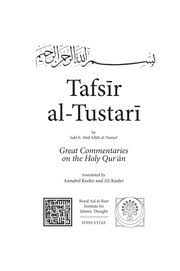
from Sahl Tustari’s (d. 283/896) Qur’anic Commentary and Rumi’s Mathnawi: Part 1
One of the most frequently reiterated motifs in Tustari’s mystical interpretation of the Qur’an is that of the struggle between the flesh and the Spirit, that is, between the anima bruta (referred to in Qur’anic Arabic as al-nafs al-ammara: ‘the soul that incites one to pursue vice’) and the higher spiritual faculties in man, which include the conscience (al-nafs al-lawwama, literally: ‘the soul that blames’) and ‘the soul at
peace’ with God (al-nafs al-muta’inna).
Since this motif is the central subject of all religious ethics in Islam in general and Sufi moral teachings in particular, it is appropriate if we begin our discussions here.
In many of his mystical interpretations of the Qur’an’s verses, Tustari compares and contrasts the spiritual to the material aspects of humanity. The following two examples may serve to exemplify his approach:
And if two parties of believers fall to fighting, then make peace
between them. And if one party of them does wrong to the other,
fight that which does wrong till it return unto the ordinance of
God; then, if it return, make peace between them justly, and act
equitably. Lo! God loves the equitable (Qur’an XLIX: 9).
According to Tustari’s interpretation of this verse, the two struggling forces mentioned here are symbols for opposing faculties of the soul fighting within man:
The outward meaning of the verse is as those specialised in exegesis have explained.
However, in its inner meaning it refers to the spirit (ruh), intellect (caql ), heart (qalb), basic nature (tabc), desire (hawa) and lust (shahwa). If natural instinct, desire and lust take up arms against the heart, intellect and spirit, the servant must fight them with the swords of vigilance (muraqaba), the arrows of inspection (mutalaca) and the lights of conformity (muwafaqa), so that the spirit and the intellect gain the upper hand, and desire and lust are vanquished.
As we can see from his exegesis, in Tustari’s view the esoteric sense of the verse refers to the perpetual struggle between the flesh and the Spirit ongoing within man. Elsewhere in his commentary he contrasts spiritual and sensual pleasures using his own distinctive terminology, declaring that: ‘heavenly pleasures and goods are the rewards for the ‘natural soul’ (nafs al-tabc), whereas realization of divine unity
(tawhid ) and the Visio Dei (liqa) are the reward for the spiritual soul (nafs al-ruh)’.
In this respect, it is illuminating to consider Tustari’s interpretation of another passage of the Qur’an: ‘And had We willed, We could have raised him by their means, but he clung to the earth and followed his own lusts’ (VII: 176). Tustari does not concentrate on the exoteric sense of the verse, which concerns the ill-fated Balcam, son of Boer, a
Canaanite descended from Lot who opposed Moses and his people, but focuses on the inner meaning of self-abasement before God:
The self (nafs) has seven heavenly veils and seven earthly veils.
The more the servant buries his [lower] self in the earth the higher will his heart soar heavenwards. Furthermore, if he [completely] buries his lower self beneath the earth his heart will reach the Throne.
The core theme of the Mathnawi is likewise the spiritual warfare of the Intellect with the ego-self (nafs), the epic struggle of the Spirit against the lower soul and its passions constituting the very warp and woof of Rumi’s vast poem. Exactly how much Mawlana owed to the previous heritage of theoretical Sufism, speculative mysticism, and
esoteric Qur’an exegesis is clear when we read the following verses:
The sensuous eye is the horse, and the Light of God is the rider:
without the rider the horse itself is useless.
Therefore, train the horse (so as to cure it) of bad habits; else
the horse will be rejected before the king.
The Light of God mounts (as a rider) on the sensuous eye, and
then the soul yearns after God.
Go towards a sense on which the Light is riding: that Light is a
good companion for the sense.
The Light of God is an ornament to the light of sense: this is the
meaning of light upon light.
The light of sense draws (a man) towards earth; the Light of God
bears him aloft,
Because sensible things are a lower world: the Light of God is
(as) the sea and the sense as a dewdrop.
Although it cannot be said that Mawlana drew upon Tustari’s esoteric interpretation of the passages from the Qur’an cited above (XLIX: 9; VII: 176) or quoted directly from it in these verses, the similarities between his symbolic imagery and the hermeneutical approach of Tustari appear to be self-evident.
- The ANIMA BRUTA or ‘Calf of the Lower Soul’ (GAV-I NAFS)
The term anima bruta – or, to give the Perso-Arabic term, the ‘Calf of the Lower Soul’ (gav-i nafs) – is used throughout both the Mathnawi and in certain mystical commentaries on the Qur’an as a symbol for bodily pleasures, fleshly lusts, and carnal passions. While commenting on this Qur’anic verse: ‘And when Moses said unto his people: O my people! Ye have wronged yourselves by your choosing of the calf (for
worship) so turn in penitence to your Creator, and kill yourselves’ (II: 54), Sulami cites this comment by Ibn cAta’ (d. 309/921): ‘The lower soul or ego-self (nafs) of people is their calf; whoever is able to slay this calf and struggle against their lower soul’s vices and passions will be released from its torment and oppression.’
In the cAra’is al-bayan fi haqa’iq al-Qur’an, the mystical interpretation of the Qur’an by
Ruzbihan Baqli of Shiraz (d. 606/1210), the calf symbol in this verse is likewise interpreted as an esoteric allusion to the anima bruta (al-nafs al-ammara).
In the various passages of the Mathnawi where Mawlana refers to this particular Qur’anic parable, he presents a virtually identical exegesis to that of Sulami and Ruzbihan, at least in terms of imagery and ideas. For example, in Book III, he states:
Kill your fleshly soul and make the world (spiritually) alive; it (your fleshly soul) has killed its master: make it (your) slave.
. . . The fleshly soul says, ‘How shouldst thou kill my “calf”?’ —
Because the ‘calf’ of the fleshly soul is the (outward) form of the body.
In Book VI he again harks back to same theme, while referring to the tale of Moses and Golden Calf:
Like the people of Moses in the heat of Desert, thou hast remained
forty years in (the same) place, O foolish man. (still) in the first stage of thy journey.
Thou wilt never traverse this three hundred years distance so
long as thou hast love for the calf.
Until the fancy (illusion) of the calf went out of their hearts, the
Desert was to them like a blazing pool.
- The Idol of the Lower Soul
The passions of the lower soul are so all-absorbing and enthralling that one often follows its caprices, indulges its whims, and venerates its every desire as though it were an idol. It is for this reason that the traditional Sufi adage: ‘The lower soul is verily the mother of all idols’ (al-nafsu hiya ummu ’l-asnam) likens the lower soul to an idol.
In his interpretation of the verse, ‘And preserve me and my sons from serving idols’ (XIV: 35), Sulami cites a statement by Ibn cAta’, who quipped that ‘the idol of passion is the worst idol’.
Rumi adopts exactly the same simile in these well-known verses from the first book
of the Mathnawi:
Inasmuch as he did not give due punishment to this idol of self,
from the idol of his self the other idol was born.
The idol of your self is the mother of (all) idols, because that
(material) idol is (only) a snake, while this (spiritual) idol is a dragon.
- Altruistic Self- Sacrifice and Generosity of Soul
The idea that true generosity lies in acts of self-sacrifice involving relinquishing bodily pleasures and extinguishing the fire of passion appears at first sight to be one of Rumi’s original poetic coinages.
However, on closer examination, we find that the theology underlying this doctrine is derived from traditional Sufi exegeses on this Qur’anic verse: ‘You will not attain to piety (al-birr ) until ye spend of that which ye love’ (III: 92).
Tustari interprets this verse to mean: ‘You will not attain full piety until you go to war with your lower selves and
spend of what you love’, adding: ‘There is no spending (infaq) like consuming (infaq) the lower soul by opposing it and by seeking the good pleasure of God, Mighty and Majestic is He.’
Tustari’s exegesis of the inner meaning of generosity here finds a direct reprise in these verses by Rumi:
Munificence is the abandonment of lusts and pleasures; no one who is sunken in lust rises up (again). This munificence is a branch of cypress of Paradise: woe to him
that lets such a branch go from his hand.
Fasting and Eating HALAL Food
Throughout the Mathnawi Mawlana lays considerable emphasis on the spiritual advantages to be reaped from fasting and hunger. In several passages he also stresses the importance of consumption of proper halal food, that is, food obtained in accordance with Islamic dietary laws. In the beginning of Book II of the Mathnawi, he describes the mouth as the gateway to Hell. Hunger, on the other hand, he opines, is the sultan of all medicinal remedies, a remedy best suited to advanced spiritual adepts:
Indeed hunger is the king of medicines: hark, lay hunger to the
heart, do not regard it with such contempt.
. . . Hunger is bestowed as a gift on God’s elect (alone), that
through hunger they may become puissant lions.
The comparison of hunger to ‘medicine’ advocated by Rumi here, harks back to traditional Sufi spiritual psychology according to which hunger was considered to be the best means to treat various ailments of the soul. In the quaternion of remedies for diseases of the soul, hunger features chief, according to both Tustari and Abu Hamid alGhazali. In his Treatise on the Diseases of the Soul Sulami wrote: ‘The passions of the lower soul are strengthened through satiety; satiety prompts one to seek indulgence and incites the heart to pursue its passions and pleasures and to become lethargic. Hunger, however, weakens the lower soul, dissuades it from the pursuit of pleasures and self-indulgence, so the heart can dominate and subjugate it.’
This same notion is reiterated throughout the Mathnawi. In the following verses, Rumi describes food sourced by proper (halal) means as the source of interior illumination and wisdom:
The mouthful that gave increase of light and perfection is obtained from lawful earnings.
From the lawful morsel are born knowledge and wisdom, from the lawful morsel come out love and tenderness.
. . . The morsel is seed, and thoughts are its fruit; the morsel is the sea, and thoughts are its pearls. From the lawful morsel in the mouth is born the inclination to serve (God) and the resolve to go to yonder world.
Rather than simply admonishing the reader to pursue salvation by slavish adherence to the outward Muslim code of alimentation, that is, the dry doctrine of solely eating ‘religiously permissible food’ (halal ), the context of this passage is far broader in meaning, containing manifold significances: (1) to avoid illegal means of securing one’s livelihood and subsistence, (2) to abstain from the consumption of irresponsibly sourced food, and (3) to refrain from wasting one’s time lest it be ‘consumed’ by association with base folk and thus become ‘devoured’ by bad thoughts.
In this respect, Tustari’s interpretation of the following verse: ‘Eat and drink, but be not prodigal. Lo! He loveth not the prodigals’ (Qur’an, VII: 31) merits citation and comparison:
God, Exalted is He, created the world and placed knowledge and wisdom within hunger ( juc), and placed ignorance and transgression within satiety (shabc). So, when you are hungry ask for satiety from the One who has afflicted you with hunger, and if you are satiated, ask for hunger from the One who has afflicted you with satiety, otherwise you will commit excesses and transgress. Then he recited: ‘Nay, but verily man is wont to rebellious – that he thinks himself independent.’
He also said: ‘Truly, hunger is a secret among the secrets of God, Exalted is He, on earth, which He does not entrust to anyone who will disseminate it.’
When describing a Sufi teacher rebuke his disciple’s dread of going hungry, Mawlana apparently had this selfsame adage in mind when he composed these verses:
You are not (one) of the honoured favourites (of God) that you
should be kept without walnuts and raisins.
Hunger is the daily bread of the souls of God’s elect: how is it
amenable to (in the power of ) a beggarly fool like you?
Be at ease: you are not (one) of those, so that you should tarry
without bread in this kitchen.
From the citations given above, it seems evident that Rumi was influenced by Tustari’s School in which the consumption of religiously permissible food (halal ) had special importance. In his interpretation of the verse: ‘And whatsoever the messenger gives you, take it, and whatsoever he forbids, abstain from it’, Tustari commented: ‘The principles of our school are three: consuming what is legitimate (aklal-halal ); following the example of the Messenger in his character (akhlaq) and actions (af cal ), and sincerity of intention (ikhlas al-niya) in all works.’
The hidden Hierarchy
The principle of avoiding causing harm and distress to others (in Persian: tark-i azar ) was a doctrine of fundamental importance to the Sufis, with whole chapters of Sufi manuals often devoted to it and Sufi poets constantly reiterating it as one of their key ethical teachings.
The doctrine is ultimately traceable back to the description of the generously magnanimous nature of the friends of God given in the Qur’an: in particular, to one verse where we read: ‘And the believers, men and women, are protecting friends one of another’ (IX: 71). Tustari interpreted this verse to mean: ‘A person’s protective friendship (muwalat ) towards the believers is his avoiding doing them any harm.
. . . Know that the servant does not attain true faith (haqiqat al-iman) until he becomes as the earth for the servants of God — it endures the suffering that they impose upon it, and they derive benefits from it.’
As these verses from the Mathnawi about the long-suffering patient endurance of God’s friends illustrate, exactly the same ethical teaching was also of special significance to Mawlana:
The chosen servants of God are merciful and long-suffering: they possess the disposition of God in regard to putting things right. They are kind and bribeless ones, helpers in the hard plight and the heavy, grievous day.
But God’s friends (awliya’ ) are not only endowed with sublimely altruistic ethics, they constitute a kind of esoteric pantheon who rule the world, that is, a hidden hierarchy of saints who invisibly protect humankind from tribulations, disasters and affliction.
The theory of the esoteric hierarchy of God’s friends or saints who secretly direct and oversee the world’s affairs is elaborated throughout Sulami’s exegesis on the Qur’an. Apropos of the following verse: ‘And the earth have We spread out, and placed therein firm hills (rawasi )’ (XV: 19), Sulami pronounces: ‘The meaning of “firm hills” is the hierarchical degree and the spiritual state of God’s friends, who have been appointed by God as a means to repel disasters, so that due to their position all indecent acts are prevented . . . these friends of God give shelter to, and are a source of, consolation and protection for God’s servants in times of trouble and affliction.’
Upon another verse: ‘And We appointed from among them leaders who are guided by Our command’, Sulami likewise cites this saying by Abu Sacid Kharraz (d. 286/899): ‘God’s adepts who have verified the truth of things have a certain ethical pre-eminence over others. They avoid causing harm, offence or distress to others, and exhibit patience in face of affliction and tribulation. They live among others without standing out or being noticed, and even though they are the preservers of mankind, no one pays them any particular regard, which is the meaning of God’s word: “We appointed from among them leaders.”’
The theory of God’s saints who direct the hidden hierarchy of the world and provide assistance, both manifest and hidden, to humankind, elaborated by Sulami above, is likewise one of the Mathnawi’s core themes, as these verses attest:
The valiant holy men are a help in the world when the wail of the oppressed reaches them. From every quarter they hear the cry of the oppressed and run in that direction, like the mercy of God. Those buttresses for the breaches of the world, those physicians for hidden maladies, Are pure love and justice and mercy; even as God, they are flawless, incorruptible and unbribed.
Concealment of Foibles and Condemnation of Fault-finding
Turning from the hidden spiritual hierarchy of the invisible realm to the exoteric social structure of medieval Islamic society, another fundamental theme found throughout the commentaries of both Tustari and Sulami – a theme also reiterated in many places in Rumi’s Mathnawi – is the ethical precept of overlooking the faults of others (cayb-pushi ) and, simultaneously, reviling the evils of exposing the flaws of one’s neighbour (cayb-ju’i ).
In this respect, it is illuminating to read Tustari’s interpretation on this key verse: ‘O ye who believe! Shun much suspicion; for lo! some suspicion is a crime. And spy not, neither backbite one another. Would one of you love to eat the flesh of his dead brother? Ye abhor that (so abhor the other)! And keep your duty (to God). Lo! God is Relenting, Merciful.’
Asked in this context about the meaning of the Prophet’s words ‘Be on your guard with
people, [by holding a] bad opinion (ihtarisu al-nas bi su’ al-z. ann)’,
Tustari replied:
The meaning of this is [that protection from people] is [gained by holding a] bad opinion of yourself, not of other people. In other words, accuse your own self for not treating them fairly in your dealings with them.
[Concerning ‘And spy not . . .’], he said: ‘Do not search out the faults that God has covered for His servants, for you may well be afflicted by that [fault]’. It was related of Jesus that he used to say, ‘Do not speak too much other than in remembrance of God, Mighty and Majestic is He, for your hearts will be hardened, and the heart that is hard is far from God. Do not regard the faults of people as if you were their masters, but look at your own works as if they were your slaves. Know that people are either afflicted (mubtala) or preserved (mucafa), so show mercy to those who are afflicted and ask God for preservation.’
The innumerable strictures made by Mawlana against censuring the vices of others while not censoring one’s own faults is a key theme in the Mathnawi that would require a separate essay itself to expound.
However, some of the following verses merit citation in this respect:
Do not you, then, whatsoever grief befall you, resentfully accuse any one: turn upon yourself.
Do not think evil of another, O you who gratify the desire of your friend: do not that which that slave was meditating.
. . . You also are bad and malign to others outside, while you have become complaisant to the grievous self and carnal soul within.
It is your enemy indeed, yet you are giving it candy, while outside you are accusing every one.
Rumi’s denunciation of fault-finding reappears in Book III with the following subtitle: ‘Explaining what is signified by the far-sighted blind man, deaf man who is sharp of hearing, and the naked man with the long skirts.’ The avarice of the far-sighted blind man, he explains, makes him utterly blind to his own faults while perfectly cognizant of others’ foibles and peccadilloes:
The blind man is Greed: he sees other peoples faults, hair by hair and tells them from street to street (But) his blind eyes do not perceive one mote of his own faults, albeit he is a fault-finder.
The naked man is afraid that his skirt will be cut off: how should they (any one) cut off the skirt of a naked man?
But the friends of God are quite the opposite: they conceal the faults of their neighbours:
He knows and keeps riding on silently: he smiles in thy face in order to mask (his feelings).
. . . He knows and by command of Almighty he conceals (it), for it would not be lawful to divulge the secret of God.
From the above passages it is easy to see how close Mawlana’s views about fault-finding are to those of Sahl Tustari. Referring to this phrase ‘neither backbite one another . . .’ in same verse of the Qur’an cited above, Tustari enjoins: ‘Whoever wants to be safe from backbiting should bar the door to ill assumptions (z. unun) in himself, for whoever is safe from making ill assumptions, is safe from backbiting (ghayba), and whoever is safe from backbiting, is safe from calumny (zur ), and whoever is safe from calumny, is safe from slander (buhtan).’
Exactly these sentiments are expressed in these famous lines by Rumi about the importance of good manners and the virtue of forbearance:
O Muslim, whilst you are still engaged in the quest, good manners are indeed nothing but forbearance with every one that is unmannerly.
When you see any one complaining of such and such a person’s ill nature and bad temper, Know that the complainant is bad-tempered, forasmuch as he speaks ill of that bad-tempered person, Because he alone is good-tempered who is quietly forbearing towards the bad-tempered and ill-natured.
Conclusion
Although Mawlana had recourse to diverse textual and contextual methods of exegesis of the Qur’an in order to expound his own viewpoint and ideas, it is quite evident that he propounded his own particular esoteric approach to various verses of the scripture throughout the Mathnawi.
However, his aim was neither aesthetic elaboration nor literary elucidation of individual verses, nor was he interested in highlighting the contextual historical meanings of any its verses. Rather, his focus was on the esoteric significance of the Muslim missal, wherein he sought to reveal the secondary, hidden connotations par derrière de la lettre of the text in order to disclose the spiritual and moral meanings that lay secreted therein.
The fundamental aim of Rumi’s mystical thought in the Mathnawi is one of moral prescription, his objective being to cure the afflictions of the soul and find remedies for psycho-spiritual diseases. His poetry in this sense is homiletic, aiming to better comprehend and hence expound and remedy the maladies of the lower soul and the foibles of egocentric self-absorption that accompanied them. It is largely to this end that he has recourse to citation of passages from the Muslim scripture. Since his esoteric approach to the Qur’an was a matter of practical ethics and not abstract theoretical hermeneutics, he also easily managed to elaborate his own independent, mythopoetic vision of the world and man, and to develop his own unique theocentric humanistic thinking that has made his thought and verse admired by votaries of all faiths and sects the world over.
To some extent, we find echoes of Mawlana’s hermeneutical approach in the grand commentaries on the Qur’an by Sahl Tustari and Sulami written in the ninth century.
During the twelfth century, the works of these classical exegetes were later reclaimed and developed to their full maturity in the Sufi poetry of Sana’i and in the mystical theology of Abu Hamid al-Ghazali, whose esoteric mode of thinking continued to dominate the mainstream of Persian Sufi mystical literature thereafter.
Finally, drawing on these rich veins of mystical exegesis developed over the previous four centuries, in the thirteenth century Rumi turned his own Mathnawi into an independent, esoteric commentary on the Qur’an, declaring it in fact to be a veritable ‘Decoder of the Qur’an’. How and why this is so, we hope to have partially shown above.
In the second, concluding part of this essay, forthcoming in the Mawlana Rumi Review, vol. VII, we continue to explore how Rumi addresses another wide range of Sufi themes – tribulations and trials, divine deceit or God’s guile, the importance of trustworthiness in concealing secrets, the doctrine of trust in God and renunciation of personal contrivance and volition, the necessity of maintaining a positive and good opinion of the ways of God, the doctrine of the abandonment of secondary causes, and finally, the role and meaning of supplication and invocation in the spiritual life – showing how many of his expressions in the Mathnawi about these topics have their source in the commentaries on the Qur’an by Sahl Tustari, Sulami, and other early classical commentators. See Sahl Tustarī’s (d. 283/896) Esoteric Qur’ānic Commentary and Rūmī’s Mathnawī: Part 2














 Sufi Path of Love