– Qurbani : -The aim of sacrifice is to imbibe piety and self righteousness. It also promotes the spirit of sacrifice for a right cause. To explain its purpose, God says in the Quran. “It is not their meat, nor their blood, that reaches God, It is their piety that reaches God”: (22:37).
Qurbani goat costs : 130 euros
– Costs Ram Qurbani : 160 euros
–Costs Ox/beef: 840 euros (7x 120)
– all donations are also welcome to help develop the new Dergah in Abidjan
– Sheikh Nazim Madrassa School is open! Support them so they can grow
On the occasion of ʿĪd al-Aḍḥā 2025, we are organizing a Qurbani (ritual sacrifice) event for the needy. All animals will be sacrificed according to prophetic tradition, and the meat will be distributed free of charge to the poorest families and people with mental health problems at the Zawiyah Mawlānā Shaykh Muhammad Nāẓim, as well as in other cities across the country, in a spirit of sharing, brotherhood, and raḥma (mercy). This is a blessed opportunity to share the joy of the festival with the villagers and to demonstrate the generosity and nobility of the Muslim community. Participating in Qurbani means offering a meal, but also love, respect, and presence. All donations are welcome to contribute to the development of the new Dergah in Abidjan. Sheikh Nazim: The Madrassa school is open! Support them so they can grow.
All donations must be accompanied by the reason for the donation (Qurbani, Madrassa, or Zawiyah), and the name to be associated with it, if applicable.
Moneygram/RIA: Last Name SAVANE / First Name Aboubakar
BE 11 063221 2197 6148= iban bank number Sheikh Aboubakar’s WhatsApp number: +33 6 43 96 58 70
“Hail, O Love that bringest us good gain—thou art the physician of all our ills”
–Rūmī
The outpouring of interest in RūMī(1207-1273) or as he is known within the world of Islamic spirituality, Jalāl al-Dīn Muḥammad Rūmī or simply Mawlānā, “our Master,” in the contemporary West is an overwhelming confirmation of the timeless relevance of traditional wisdom that isneither of the East or West. He is the originator of the renowned “mystical dance” (semā), which later became known as the “dance of the whirling dervishes” that is utilized by the Mevlevi or Mawlawiyya Sufi order founded by Rūmī ’s followers after his death. How is it that a poet from the thirteenth-century born in Balkh (Khurasan or present-day Afghanistan), who lived most of his life and was buried in Konya (Turkey), has become a celebrated figure in America today? This is again evidence of his universal message that transcends religious and sectarian boundaries, national, cultural, and ethnic divisions and is not limited to time or place. With the rise of Islamophobia, including extremism and xenophobia in all its forms, the message of the saints and sages such as Rūmī provide an antidote to the increasing ignorance, hatred, and violence that are besieging the world today. THE SUFI DOCTRINE OF RUMI is a revised edition of a work that was initially published in 1974 in Iran by the Aryamehr University in Tehran to celebrate the seven-hundredth anniversary of Rūmī ’s death, when Professor Chittick was an assistant professor of Religious Studies at the university. This new edition is colorfully decorated with calligraphy, Persian and Turkish miniature paintings, which are truly stunning for the eye to gaze upon. Seyyed Hossein Nasr, one of the world’s most respected writers and speakers on Islam and its mystical path, Sufism, was then the Chancellor of Aryamehr University. Nasr discusses the importance of this work for future Rūmī studies in his Foreword to this book: [This] study of Dr. Chittick has the great merit…of approaching the subject [of Rūmī’s metaphysical teachings] from a strictly traditional point of view untainted by the modernistic fallacies which have colored most of the other studies devoted so far to this subject in Western languages.… May the message of Rūmī serve as a beacon of light to dispel the shadows which prevent modern man from seeing even his own image in its true form and from knowing who he really is.
Rūmī ’s major works are the DīWāN-I SHAMS-I TABRīZī of some 40,000 verses, and the MATHNAWī containing some 25,000 verses, which is often regarded as “the Qu’ran in the Persian language.” Although no work could fully encompass the totality of Rūmī ’s teachings, readers may ask, why yet another book? While numerous books are available they often miss the mark, and do not provide insight into the mystical symbolism of Rūmī ’s spiritual universe. Chittick speaks to his intentions behind preparing this work: Despite numerous studies of him [Rūmī], until now there has been no clear summary in English of the main points of his doctrines and teachings…. For those who know [ Rūmī] only through the popularizing translations [of his poetry], this little book may provide some insight into his universe of meaning. Unlike most Sufi poets, Rūmī explains the meaning of his imagery and symbolism. My task is simply to juxtapose various verses and prose passages to let him say what he wants to say.
While Rūmī is well-known, and celebrated in the present-day, what is lacking are authoritative works accessible for general readers that offer an introduction in clear and accessible language to his magical poetry. This book does just that as it provides an authoritative and accessible presentation of Rūmī ’s magisterial teachings and its fundamental themes vis-à-vis the Islamic tradition, which is central to his spiritual universe. The lack of knowledge pertaining to the Islamic tradition tends to obstruct Western readers from understanding the depth of Rūmī. Sufism is regarded as the inner or esoteric dimension of Islam and is a spiritual path by which the human being can transcend his or her individual egoism to reach the Divine. Chittick explains the distinction and relationship between the inner and outer dimensions of religion: Exotericism by definition must be limited in some sense, for it addresses itself to a particular humanity and a particular psychological and mental condition— even though its means of addressing itself is to some degree universalized and expanded through time and space to encompass a large segment of the human race. Esotericism also addresses itself to particular psychological types, but it is open inwardly towards the Infinite in a much more direct manner than exotericism, since it is concernedprimarily with overcoming all the limitations of the individual order.
Chittick clarifies the role of the Prophet Muhammad within Sufism as some have tried to separate Sufism from the Islamic tradition as if one could be a Sufi without being a Muslim: For the Sufis themselves one of the clearest proofs of the integrally Islamic nature of Sufism is that its practices are based on the model of the Prophet Muhammad. For Muslims it is self evident that in Islam no one has been closer to God—or, if one prefers, no one has attained a more complete spiritual realization—than the Prophet himself, for by the very fact of his prophecy he is the Universal Man and the model for all sanctity in Islam. For the same reason he is the ideal whom all Sufis emulate and the founder of all that later become crystallized within the Sufi orders. Rūmī confirms that all Sufi orders link back like a chain (silsilah) to the Prophet and that without the Prophet Muhammad there would be no Sufism. This is expressed in his lyrical verse:
“God’s way is exceedingly fearful, blocked and full of snow. He [the Prophet] was the first to risk his life, driving his horse and pioneering the road. Whoever goes on this road, does so by his guidance and guarding. He discovered the road in the first place and set up waymarks everywhere.”
To the surprise of many Rūmī admirers, who would never accuse him of being narrow-minded, rather than being against orthodox interpretations of religion, Rūmī speaks of orthodoxy as a spiritual necessity to the union with the Divine: “The (right) thought is that which opens a way: the (right) way is that on which a (spiritual) king advances.”
The following is another poetic articulation of Rūmī ’s perspective on orthodoxy: “Alter yourself, not the Traditions: abuse your (dull) brain, not the rose-garden (the true sense which you cannot apprehend).” According to Rūmī, the true nature of the relationship between the Divine and the world of form requires a transcendent wisdom that is outside the reach of normal or rational knowledge:
It…is neither inside of this world nor outside; neither beneath it nor above it; neither joined with it nor separate from it: it is devoid of quality and relation. At every moment thousands of signs and types are displayed by it (in this world). As manual skill to the form of the hand, or glances of the eye to the form of the eye, or eloquence of the tongue to the form of the tongue (such is the relation of that world to this).
Although the Divine confirms the unity of all phenomena in the manifest world, when viewed through the lens of the relative or duality, all things appear as separate and disjointed from one another without a trace that they are essentially interconnected on a higher level. Likewise, knowledge cut off from its transcendent source characterizes the fallen consciousness of humanity. Chittick writes, “The fall of man is the result of the blinding of the ‘eye of the heart’ (chashm-i dil or ‘ayn al-qalb), which alone sees with the vision of gnosis.” Due to the fallen consciousness which attaches itself to what is transitory, human beings do not see things as they are but rather in a distorted way: “Therefore union with this (world) is separation from that (world): the health of this body is the sickness of the spirit. Hard is the separation from this transitory abode: know, then, that the separation from that permanent abode is harder.”
According to Rūmī, the fallen consciousness of Adam extends and includes the whole of humanity:
Sick, surely, and ill-savored is the heart that knows not (cannot distinguish) the taste of this and that. When the heart becomes whole (is healed of pain and disease), it will recognize the flavor of falsehood and truth [since “God taught Adam the Names”]. When Adam’s greed for the wheat [the forbidden fruit] waxed great, it robbed Adam’s heart of health ….discernment flees from one that is drunken with vain desire.
The loss of the sense of the sacred is itself the forgetting of the Divine. Rūmī asserts, “Forgetfulness (of God), O beloved, is the pillar (prop) of this world; (spiritual) intelligence is a bane to this world.” Sufism teaches that Universal or Perfect Man (al-insān al-Kāmil) is the prototype of both the microcosm and the macrocosm, the human being and the cosmos. This is to say that Universal or Perfect Man is “the perfect human model who has attained all the possibilities inherent in the human state.” For Universal or Perfect Man the misidentification with the empirical ego has relinquished itself, “the human ego with which most men identify themselves is no more than his outer shell”. Chittick explains the need for consciousness to be in ceaseless contemplation of the Real in order to remedy the forgetfulness of the Divine: “the maintenance of the world depends on the balance between the contemplative who has realized the state of Universal Man, and fallen man, who lives in a state of forgetfulness.” The theomorphic identity of all human beings is the Universal or Perfect Man as Rūmī instructs:
The owner of the Heart [Universal or Perfect Man] becomes a six-faced mirror: through him God looks upon (all) the six directions. Whosoever hath his dwelling place in (the world of) the six directions, God doth not look upon him except through the mediation of him (the owner of the Heart)…. Without him God does not bestow bounty on any one.
Rūmī reminds readers that the original function of every human being is to be the Universal or Perfect Man in order to act as a channel of grace in the world. In fact, not to do so, is to forfeit what it means to be human:
There is one thing in this world which must never be forgotten. If you were to forget everything else, but did not forget that, then there would be no cause to worry; whereas if you performed and remembered and did not forget every single thing, but forgot that one thing, then you would have done nothing whatsoever.
The saints and sages of the world’s religions remind the human collectivity of his or her original or theomorphic nature and provide methods of realizing this transpersonal identity:
In the composition of man all sciences were originally commingled, so that his spirit might show forth all hidden things, as limpid water shows forth all that is under it—pebbles, broken shards, and the like—and all that is above it, reflecting in the substance of the water. Such is its nature, without treatment or training. But when it was mingled with earth or other colors [when Adam fell], that property and that knowledge was parted from it and forgotten by it. Then God most High sent forth prophets and saints, like a great, limpid water such as delivers out of darkness and accidental coloration every mean and dark water that enters into it. Then it remembers; when the soul of man sees itself unsullied, it knows for sure that so it was in the beginning, pure, and it knows that those shadows and colors were mere accidents.
Identity itself belongs to the Divine and thus the mystery of human identity cannot be resolved without the inclusion of what transcends the empirical ego. Rūmī astutely writes: “The idol of your self is the mother of (all) idols….” Whether the human being chooses to do good actions or evil ones, all creation confirms the existence of the Absolute. Rūmī writes,
“…(both) infidelity and faith are bearing witness (to Him): both are bowing down in worship before His Lordliness.”
The secret of the Prophetic Tradition that affirms “Die before ye die” is a call for self- effacement before the Divine in order to be reabsorbed in the Divine. Rūmī states that ultimately death in this life is an alchemical process of spiritual transformation; it is a journey of homecoming and not of departure in order to return to the Supreme Identity:
O you who possess sincerity, (if) you want that (Reality) unveiled, choose death and tear off the veil [of your self-existence]— Not such a death that you will go into the grave, (but) a death consisting of (spiritual) transformation.
Rūmī casts light on the famous, yet no less controversial dictum by the great Sufi mystic al-Hallāj (858-922), which is an instruction on how to approach the Divine: Take the famous utterance “I am God.” Some men reckon it a great pretension; but “I am God” is in fact a great humility. The man who says “I am the servant of God” asserts that two exist, one himself and the other God. But he who says “I am God” has naughted himself and cast himself to the winds. He says, “I am God”: that is, “I am not, He is all, nothing has existence but God, I am pure nonentity, I am nothing.” In this the humility is greater.
The deepening of our understanding of the mystical dimension of the religions will aid in creating more spiritual literacy across the faith traditions and will simultaneously revive the meaning and significance of the outer or formalistic dimension of religion. For Rūmī and all saints and sages of the sapientia traditions are upholding the right understanding of their own faith traditions and how to approach them accordingly.
The shahādah or the essential declaration of faith in Islam, Lā ilāha illallāh, “There is no god but God,” when seen through the discerning and contemplative “eye of the heart” becomes a crystalline distillation of Rūmī ’s metaphysical teachings. Two main steps on the Path are contained in the shahādah, the first consisting of the “annihilation of self” (fanā) and the second the “subsistence in God” (baqā), for when the illusory nature of human identity dissociated from the Divine reality is seen for what it is and it becomes evident that the Divine is all that exists, concentration on the Real becomes possible. This formula can also be understood as “There is no self but the Self” or, correspondingly, “There is no reality but the Reality,” being universal in principle and applicable to all faiths.
As the centuries pass, Rūmī continues to demonstrate his profound presence in the hearts and minds of those who are attracted to his message, which calls for nothing less than are sacrilization of this world and union with the Divine. The importance of this book is that it guides readers through the fundamental themes of Rūmī ’s complex spiritual labyrinth, making his symbolic language intelligible to readers unfamiliar with his teachings or the mystical dimension of Islam. It is truly remarkable to find the timeless in time; and it is not only through Rūmī but all of the saints and sages of the world’s faith traditions where such examples of pure metaphysics can be found, urging a resurgence of the sacred that is ever present in this very moment. We conclude with two lines from Rūmī ’s DīWāN inviting all to take part in the pilgrimage of the Heart:
“Make a journey out of self into [your real] self, O master, / For by such a journey earth becomes a quarry of gold.”
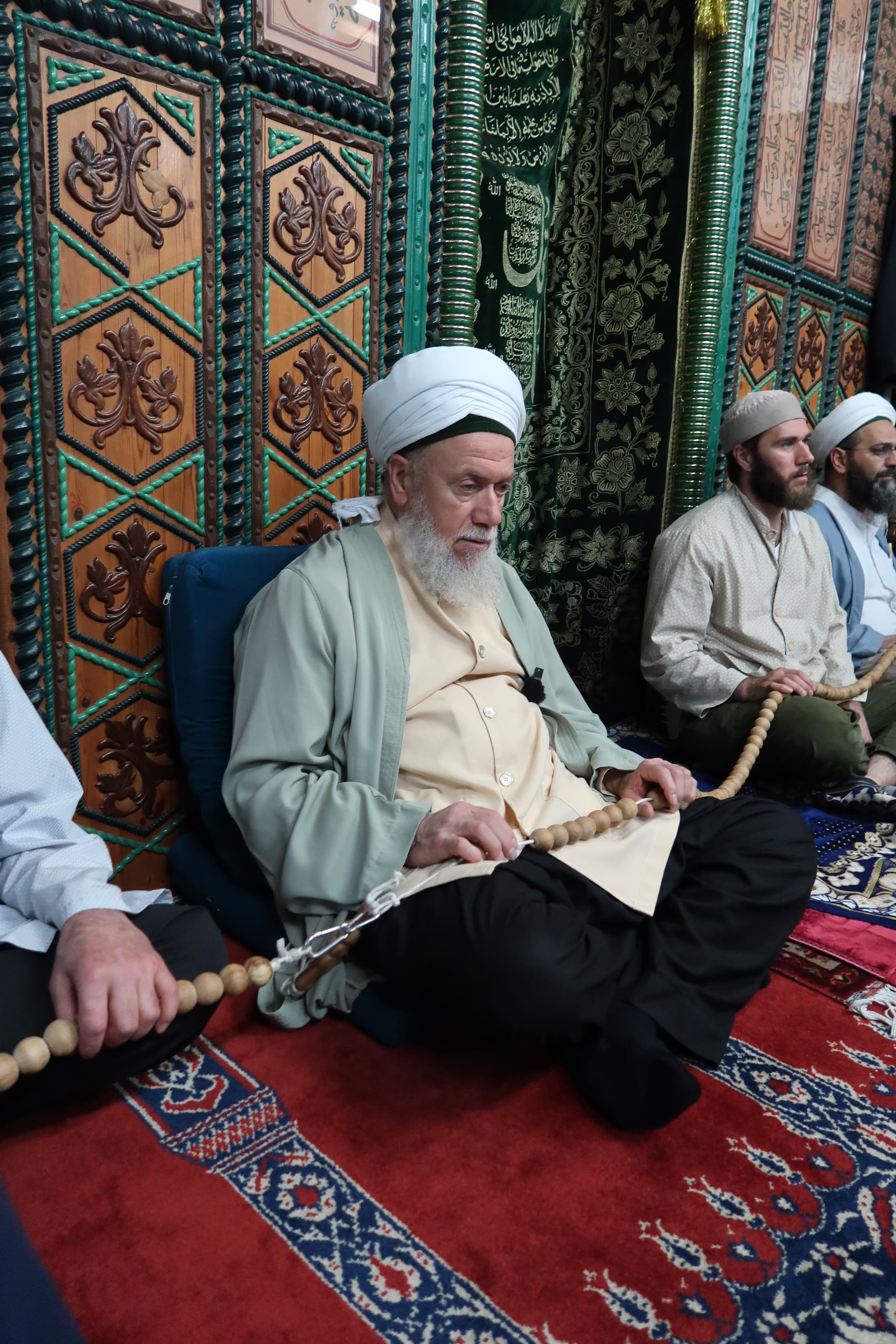
Shukr to Allāh جل جلاله, we gathered here again for the sake of Allāh جل جلاله. We gathered here to continue on that way with the beloved servants of Allāh جل جلاله. We always gather, but our gathering today is for the anniversary of the passing of the awliyā’uLlah Mawlānā Shaykh Nāẓim. He passed away, but shukr to Allāh جل جلاله, he didn’t leave us. He even didn’t leave us outwardly. He gives his madad to all his murīds. He gives them strength, spiritual power.
Sometimes many murīds ask how to make Rābita, how to hear a voice in Rābita. Rābita is your love for our Holy Prophet صلى الله عليه وسلم and to mashāyikh. To love them is our Rābita. Rābita isn’t “Should I do this? Should I not do that?” That’s fine too, but there’s no need to give instructions for Rābita, “My son/my daughter, do this, do that.” Whoever wants such things doesn’t know the principles and ethics. When you enter ṭarīqah, you surrender. You surrender to your murshid. If you’ve found a real murshid, you should thank Allāh جل جلاله not a thousand times, but a million times. When you surrender, you have reached salvation. But may Allāh جل جلاله protect us, if you get stuck with those who claim they’re murshid for another purposes , may Allāh جل جلاله help you. Because they follow their ego. And since the way is for their ego, it is of no benefit. But if you go on the way of the murshid, shukr to Allāh جل جلاله. Life is passing by anyway. Then, it won’t be wasted in vain. It will be filled with thawāb, barakh and beauty.
If you’re going to wander around striving in vain, “What should we do today? Where should we have fun today? How should we make money? How can we get intoxicated? How can we impress others to like us?” This is empty work. There’s a nice saying of the Turks, “empty work.” That’s empty work. Living for dunyā, for your own interests, for your ego is empty work. If your life is going to be full, you must go on the way of Allāh ‘Azza wa-Jalla, the way of mashāyikh, and surrender.
Don’t think that it is empty. It is filled with Allāh’s جل جلاله permission. May Allāh جل جلاله protect us. As we said, what’s empty is those who think, “How much will I earn from dunyā?” Their life passes in vain and meaninglessly. May Allāh جل جلاله protect us, apart from it being in vain, it is full of evil, full of sins. May Allāh جل جلاله protect us.
Therefore, asking himmah and help from the mashāyikh is beneficial. Being on that way with them is a protection for you. It gives value to your life. Your life becomes beneficial. “This guy lives like grass. He goes from his house to his job, and from his job to his house. He doesn’t borrow money. He doesn’t complain about the government. He doesn’t get angry at this or that.” He doesn’t live like grass. Those living like grass, living like a poisonous grass are the others. Those who think they are something and get angry at everyone. Those who expect benefit from everyone. Those who do all kinds of filth and all kinds of ḥarām to satisfy their own egos are the ones who live in vain. We must be like grass. Grass is good. There is harmful grass, and harmless grass. Everyone knows the meaning of grass. Ours is, in shā’a Llāh, of light and īmān. May we be of the servants whom Allāh جل جلاله loves. May we not be like the grass they consume, but be as the beneficial grass, in shā’a Llāh. May Allāh جل جلاله protect us.
Shayṭān has already taken over the world with his hand. He doesn’t want to leave anyone. Those who are saved cling to the rope of this way. Those who cling to Allāh جل جلاله are the ones who are saved. Others think they are saved or have won but there is no such thing. Therefore, being with mashāyikh, following them is the greatest gain for a person. Not to be on their way is a great danger. May Allāh جل جلاله protect us. Every second, every moment shayṭān may slip your feet and you will have fallen into his trap. May Allah جل جلاله protect you.
May our Shaykh’s himmah be with us. Shukr to Allāh جل جلاله, as we said, it has been eleven years since our Shaykh has passed away. But every minute we are under his gaze, we are under his himmah. Those who ask for his himmah, he will definitely come to his aid. He doesn’t leave him. There are people who don’t believe and those group who don’t believe in awliyā’, karamāt and miracles. And they claim they are Muslim. But the condition of being a Muslim is believing in the miracles of our Holy Prophet صلى الله عليه وسلم, believing in the karamāt of the awliyā’, that is also one of the fundamental conditions of the creed of Muslims.
Therefore, shukr to Allāh جل جلاله, you are here. To those who came, may Allāh جل جلاله be pleased with you. There are many who haven’t come. Their hearts are together with us. Mawlānā Shaykh Nāẓim reaches them all with the permission of Allāh جل جلاله. May Allāh جل جلاله be pleased with you. May Allāh جل جلاله change the state of this world, and send the Sāhib. As Mawlānā Shaykh Nāẓim said that Mahdi ‘alayhi s-salam will appear, in shā’a Llāh.
Wherever you look, dunyā is in the hand of shayṭān. One hundred percent in the hand of shayṭān. To get rid of shayṭān is only through Mahdi ‘alayhi s-salam. It can’t be any other way; no matter what they say.
Wa min Allāhi t-Tawfīq. Al-Fātiḥa.
“Allah created ego [nefs] and asked him to come to His presence; but ego went back. When Allah asked him to go back, he came nearer. Whatever Allah ordered, ego did the opposite. Allah asked him, ‘Who am I and who are you?’, ordering him to declare that he is servant to Him. But ego said ‘I am myself, you are yourself!’ Allah ordered to put ego into the prison of Hell’s fires for 1000 years. After 1000 years, He called him back and asked the same question. Ego gave the same reply. Thereupon, Allah ordered to put ego into the prison [of cold hells] for 1000 years. After 1000 years, He called ego again and asked the same question; ego again gave the same reply; ‘I am myself, you are yourself’, and not said ‘I am your servant’. Then Allah sentenced ego to hunger for 1000 years. When it was complete, Allah called him again and asked ‘who am I and who are you?’ Trembling, ego said, ‘I am your big servant; you are my Lord’ [meaning, ‘though being a servant to You, I am at least still superior to all Your other servants’]”
~ Mawlana Shaykh Nazim Adil Al-Haqqani
(8 March 1992 — the Peckham Mosque).
“Our donkey is our ego.” – Mawlana Shaykh Nazim
The Prophet (s), Habeebullah, what was he saying?
Allahumma laa takilnee ila nafsee tarfata `aynin
O Allah, don’t leave me to my ego for the blink of an eye.
Therefore, we are asking for heavenly support against our egos. Our ego is attacking us and asking to take the reins to make us its donkey, to do as it likes. I am using “it” because to say “that” would give it an honor. “It” is for animals and you may use “it” for that which doesn’t have any soul or living things on it. Always put Shaytan down. Put it down. Don’t give Shaytan any honor. Don’t use any honorable word for Shaytan. That is important!
I am saying A`oodhu billahi min ash-Shaytaani‘r-rajeem. O our Lord! We are asking humbly for protection against Shaytan and its followers. That is important. Dastoor yaa Sayyidee, yaa Sultaanu ‘l-Awliyaa. We are saying, O our Master, O Qutbu ‘z-Zamaan, O Qutbu ‘l-Mutassarif who has been granted from heavenly stations to look after this world and everything that is happening on it. Don’t think that this world is just left as it likes to be through space. Everything is under control very carefully, daqeeq, control must be on everything. Nothing can be in existence without its Creator knowing about it. How can it be? He creates and He knows a dharrah, an atom can’t know about itself.
You mankind, do you know about yourself? Are you able to know about yourself? Who knows? People are trying to know something around themselves but not themselves! Our eyes may look around us only but cannot look into our inner beings. If I ask you, “Where is your liver?” Many people don’t know. If we ask, “Where is your heart?” “I do not know.” Man is ignorant, fully ignorant about himself.
We are saying A`oodhu billahi min ash-Shaytaani‘r-rajeem because Shaytan is always trying to confuse people and not letting you know. It has been said that a person has 360 organs, small and big, and yet you do not know about yourself! How come you are asking to know around yourself? Don’t say that it is knowledge to look into space saying, “That is polestar, that is the sun, that is the moon, that is seven sisters, that is alpha systems.” It is nothing, it gives you nothing.
It is not real knowledge around you that you are looking at. How many of you understand yourself? How are your organs working? You are eating and enjoying it. You are drinking and enjoying but where is it going inside? What is its significance? You don’t know. You are only drinking and eating. And you man have been granted such an honor and your honor is to know! No other creature on this planet knows about themselves because they don’t have a mind or they can’t think. And their levels are animals’ levels but your level is over the level of angels!
«We ask to be no-one and nothing, For, as long as we are someone, we are not complete.»




 Sufi Path of Love