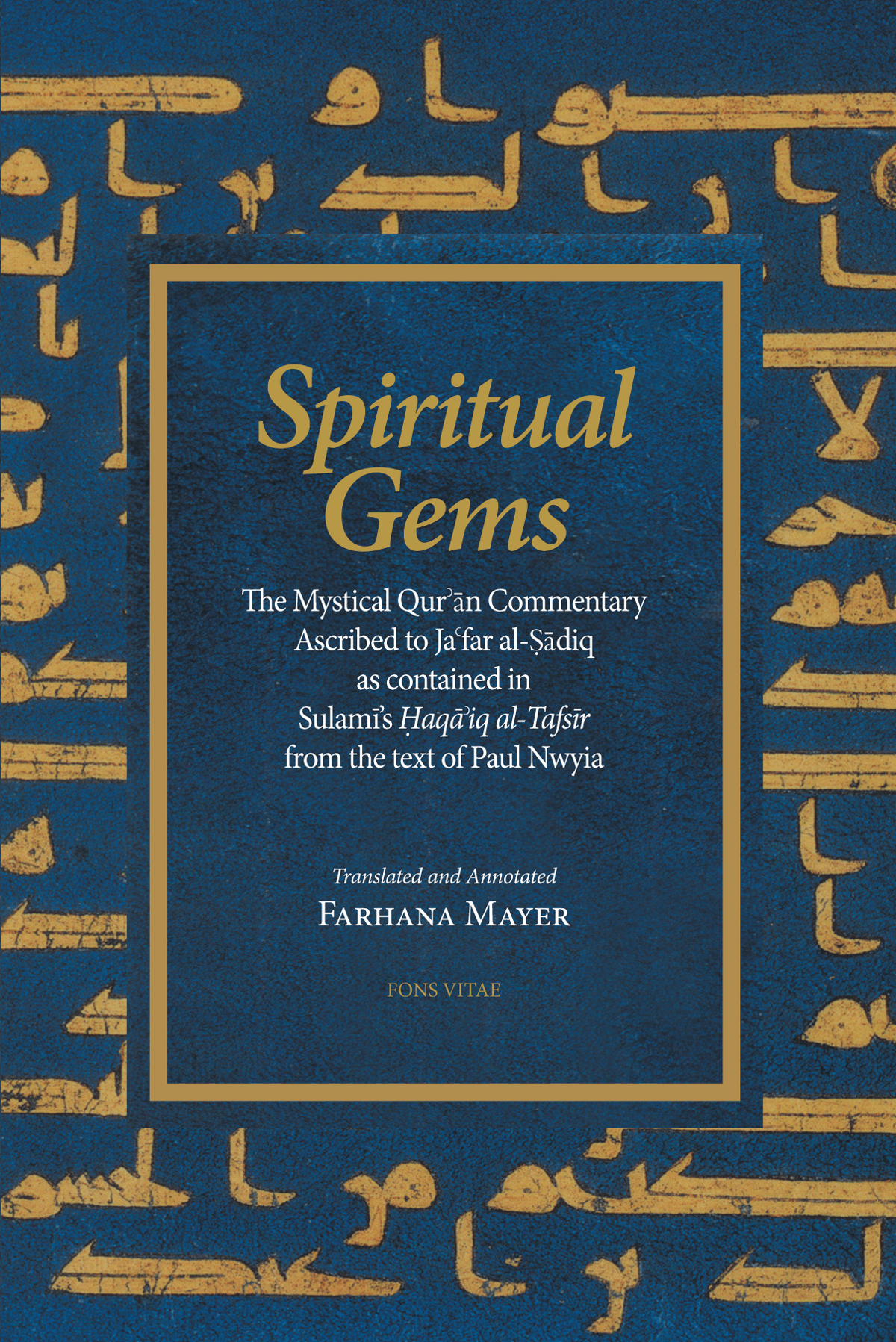
Spiritual Gems: The Mystical Qur’an Commentary, Ascribed to Ja’ far al-Sadiq

Spiritual Gems is the first ever full translation of arguably the earliest extant mystical commentary on the Qur’an. It was preserved and transmitted by the Sufis of the early centuries of Islam, and is to be found in the 4th-5th/10th-11th century compendium compiled by M.b. al-Husayn al-Sulami (d. 412/1021), in which Ja’far al-Sadiq is one of the most frequently cited authorities.

Complete with analytical introduction and scholarly notes, the book contains detailed exposition of the methods and levels of scriptural interpretations used in this commentary.

“Every verse of the Qur’an has four levels of meaning: the obvious verbal meaning, the indication or analogy, the subtle meaning, and the deepest reality.” This saying, attributed to Imam Ja’far as-Sadiq, gives us a glimpse of what we will find in the pages of this translation, compiled by as-Sulami, of the earliest mystical commentaries on the Qur’an.

Spiritual Gems helps us to understand Islamic scripture on the spiritual– and thus, universal– level. Indeed, precisely because its insights are on the spiritual level, the commonalities of theme and practice with other spiritual traditions become apparent.

This volume helps us to understand Islamic scripture on the spiritual — and thus, universal — level. Indeed, precisely because its insights are on the spiritual level, the commonalities of theme and practice with other spiritual traditions such as Kabbalah become apparent.

“Every verse of the Qur’an has four levels of meaning: the obvious verbal meaning, the indication or analogy, the subtle meaning, and the deepest reality.” This saying, attributed to Imam Ja’far as-Sadiq, gives us a glimpse of what we will find in the pages of this first ever translation of the volume, compiled by as-Sulami, of the earliest mystical commentaries on the Qur’an.

This book is important because it presents the words of mystics who were also sound scholars from the Islamic tradition. This translation gives us the raw words directly from traditional sages, accompanied by introductions of tight scholarship which give us accurate portrayal of the sages’ respective contexts.

This corpus of exegetical comments constitutes arguably the earliest extant mystical commentary on the Qur’an. It was preserved and transmitted by the Sufis of the early centuries of Islam, and is found in the fourth/tenth through fifth/eleventh century compendium compiled by al-SulamÏ (d. 412/1021), in which Jaʿfar al-Sadiq is one of the most frequently cited authorities.

Spiritual Gems is the first ever English of this important corpus from al-Sadiq. Complete with analytical introduction and scholarly notes, the book contains a detailed exposition of the methods and levels of scriptural interpretation used in this commentary and of the cognate ontological continuity between the levels of the human microcosm.

The spirituality of this text is a deeply mystical encounter with the truths enunciated by philosophy and religion. In addition to surmounting temporal differences, the inner landscape of the commentary rises above formal differences; by virtue of its universal message, it is as relevant today as it was in earlier times. Read here,free download
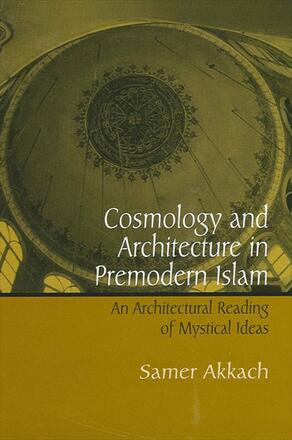
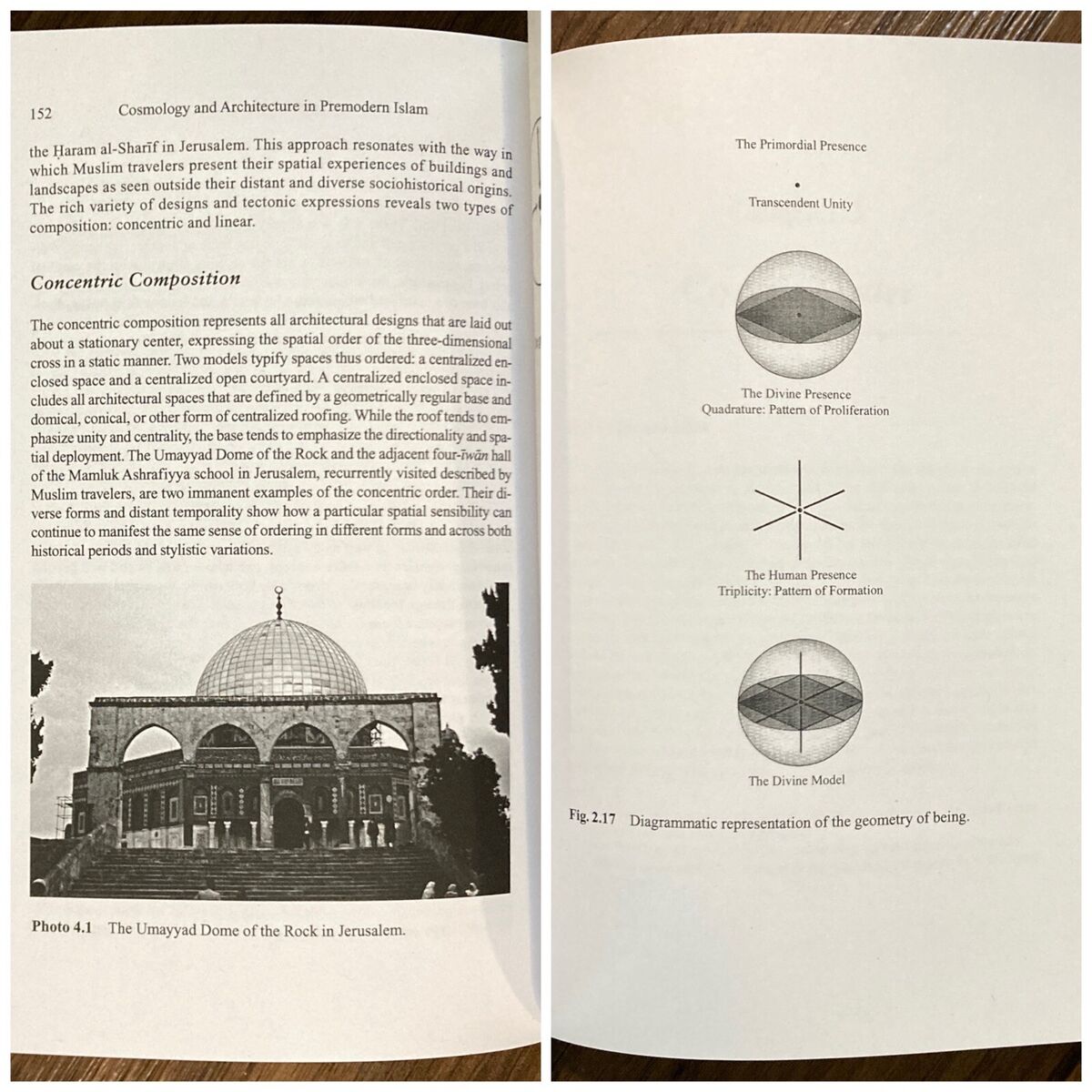
Cosmology and Architecture in Premodern Islam

Cosmology and Architecture in Premodern Islam: An Architectural Reading of Mystical Ideas Read book here

This fascinating interdisciplinary study reveals connections between architecture, cosmology, and mysticism. Samer Akkach demonstrates how space ordering in premodern Islamic architecture reflects the transcendental and the sublime. The book features many new translations, a number from unpublished sources, and several illustrations.

Referencing a wide range of mystical texts, and with a special focus on the works of the great Sufi master Ibn Arabi, Akkach introduces a notion of spatial sensibility that is shaped by religious conceptions of time and space. Religious beliefs about the cosmos, geography, the human body, and constructed forms are all underpinned by a consistent spatial sensibility anchored in medieval geocentrism. Within this geometrically defined and ordered universe, nothing stands in isolation or ambiguity; everything is interrelated and carefully positioned in an intricate hierarchy. Through detailed mapping of this intricate order, the book shows the significance of this mode of seeing the world for those who lived in the premodern Islamic era and how cosmological ideas became manifest in the buildings and spaces of their everyday lives. This is a highly original work that provides important insights on Islamic aesthetics and culture, on the history of architecture, and on the relationship of art and religion, creativity and spirituality.

In his famous Ihya Ulum al-Din (Reviving the Sciences of Religion), al-Ghazali (d. 1111), the celebrated Muslim theologian and mystic, cites an intriguing analogy. He says: “As an architect draws (yusawwir) the details of a house in whiteness and then brings it out into existence according to the drawn exemplar (nuskha), so likewise the creator (f atir) of heaven and earth wrote the master copy of the world from beginning to end in the Preserved Tablet (al-lawh al-mahf uz) and then brought it out into existence according to the written exemplar.”
In many ways, this book is a commentary on, and an exposition of, this statement, an attempt to explore the philosophical and theological contexts that give sense to such an analogy in premodern Islam. In broad terms, the book is concerned with the question of art and religion, creativity and spirituality, with how religious thought and ideas can provide a context for understanding the meanings of human design and acts of making. In specific terms, it is concerned with the cosmological and cosmogonic ideas found in the writings of certain influential Muslim mystics and with their relevance to architecture and spatial organization.

Read more here :Cosmology in Sufism

Hajja Amina Adil 1930-2004

A Fragrance of Hajja Aminah Adil

This collection of sohbats of Hajja Aminah Adil was recorded during a visit to Lefke, Cyprus between June 27th and July 30th of the year 2004. Some of them were told to the group of women who gathered around the large table in the Shaykh’s house every afternoon. Hajja Amina was well known for her stories. She gathered them from many sources. These sohbets were given in either Arabic or Turkish. She told these stories to her four children when they were growing up. Then she began telling them to the murids of the Shaykh who gathered, like her children, around her. She had a way of telling them that engaged and captivated everyone. They were a source of entertainment but they also provided subtle guidance and insight and understanding that lasts a lifetime. That is why we feel it is so important to pass themn to those who did not have the opportunity to experience themselves.   144 pages (free download)

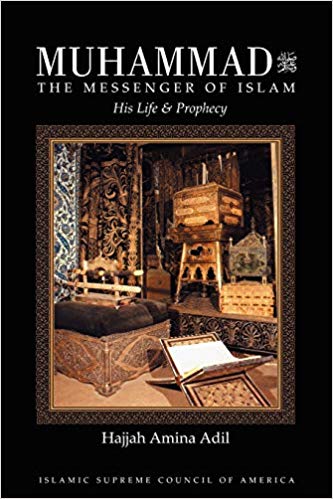
MUHAMMAD THE MESSENGER OF ISLAM

His Life & Prophecy
compiled from traditional sources in Ottoman Turkish by Hajjah Amina Adil

This impressive biographical work deftly weaves translated accounts from authentic Ottoman Turkish texts with ancient lore, resulting in a compelling, unforgettable portrait of the founder of Islam as seen through the eyes of Muslims around the world.  Dowload here